About Anyperodon leucogrammicus (Valenciennes, 1828)
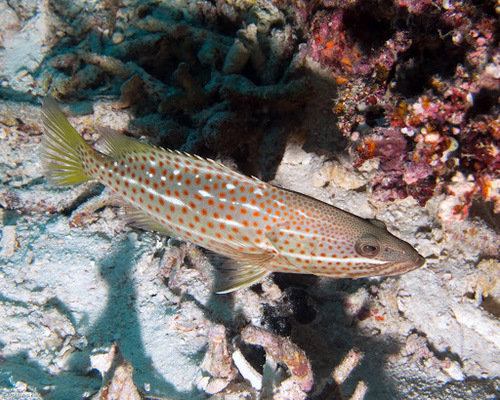
Anyperodon leucogrammicus, commonly called the slender grouper, is a medium-sized fish that reaches a total length of around 65 centimetres (26 inches). Its head makes up 40% of its total length, and it has a large mouth where the lower jaw is longer than the upper jaw. This species can be distinguished from other groupers by the absence of palatine teeth. Its base body colour is pale reddish-brown, covered generously with orange spots that are more densely packed on the head. Five pale silvery-blue longitudinal lines run along each side of its body: the lower three lines extend all the way to the tail, while the upper two break into irregular streaks. The dorsal fin has 11 spines and 14 to 16 soft rays, and the anal fin has 3 spines and 8 to 9 soft rays. Juvenile slender groupers have distinct bright blue and red longitudinal stripes. This fish has a wide distribution across the tropical Indian and Pacific Oceans, and is also found in the Andaman Sea. Its range stretches from the east coast of Africa and the Red Sea at 32°E to southern Japan and Australia at 171°W. It inhabits coral reefs, seaward reef slopes, and lagoons, occurring at depths down to 50 metres (160 feet), and occasionally as deep as 80 metres (260 feet). The slender grouper is a carnivorous species. It feeds primarily on other fish, such as goatfish, and may also consume invertebrates. Juvenile slender groupers are aggressive mimics of two species of wrasse: the red-lined wrasse Halichoeres biocellatus and the silty wrasse Halichoeres purpurescens. Juveniles match these wrasses in both appearance and behaviour, which makes potential prey fish lower their guard. This allows the juvenile grouper to approach prey undetected.