About Anurolimnas viridis (Statius Muller, 1776)
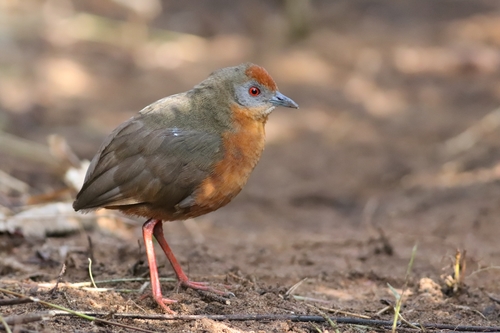
The russet-crowned crake (Anurolimnas viridis) is 16 to 18 cm (6.3 to 7.1 in) long. Males weigh 55 to 63 g (1.9 to 2.2 oz), while females weigh 69 to 73 g (2.4 to 2.6 oz). Males and females have identical plumage. Adult individuals have a black bill, red legs, a gray face, and a russet crown. The species' nominate subspecies has brownish olive upperparts and rufous underparts. Juvenile russet-crowned crakes are light brown, with a black face and dull pink legs. Adults of the subspecies A. v. brunnescens are slightly larger than the nominate subspecies, with browner upperparts and a paler head and underparts. The species is most vocal during early morning and early evening, and its call has been described as a "dry rattling like the sound of a seashell wind chime". The nominate subspecies of russet-crowned crake has a wide distribution: it ranges from far eastern Colombia and southern Venezuela east through the Guianas into Brazil, and extends south and west into eastern Peru, northern and eastern Bolivia, and eastern Paraguay. One isolated population occurs in Ecuador's Zamora-Chinchipe Province, and a second isolated population occurs in southeastern Brazil between the states of Alagoas and São Paulo. Subspecies A. v. brunnescens is found in north-central Colombia, from the lower Cauca River valley east into the middle Magdalena River valley. The russet-crowned crake is mostly a terrestrial species. Unlike many other species in its family, it is not usually found in marshes. It inhabits second-growth sapling thickets, grassy or brushy pastures, overgrown wastelands and roadsides, and gardens at the edges of small communities. It occurs at elevations ranging from sea level up to 1,200 m (3,900 ft). No documentation exists of any movements the russet-crowned crake may or may not make.