About Anurida maritima (Guérin-Méneville, 1836)
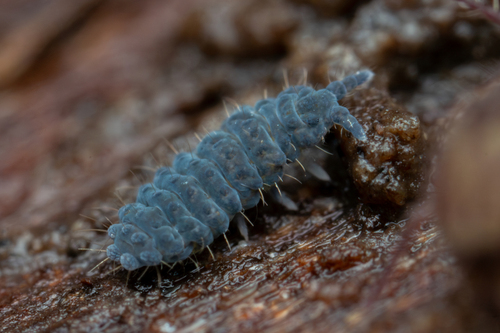
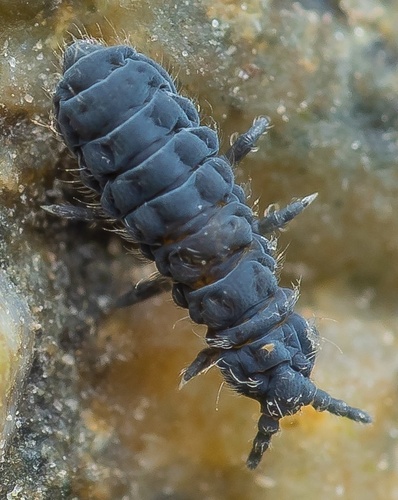
Anurida maritima (Guérin-Méneville, 1836) is a wingless animal that typically grows up to 3 mm long, and is dark slaty blue in colour. Its body is roundish, expanding slightly toward the rear. The head has a pair of eyes and a single pair of antennae; the thorax is made of three body segments, each bearing one pair of legs, while the abdomen has six segments. The entire body is covered in white hydrophobic hairs, which allow the animal to remain above the surface of the water, where it spends much of its life. Unlike other springtails, A. maritima cannot leap, because its furcula is vestigial. This loss is likely explained by disuse: when other springtails are placed on water, surface tension unfolds their furcula and leaves them unable to jump. Anurida maritima is found around the world on rocky shores and tidal marshes. In the British Isles, it is not present in north-east Scotland, and has not been recorded from south-east Ireland. It is also absent from the Baltic Sea. There have been suggestions that individuals found in northern Europe may belong to a different species than those found in the Mediterranean Sea. Anurida maritima is a significant scavenger of the upper intertidal zone, feeding on dead animals, primarily crustaceans including barnacles and molluscs. Aggregation is an important part of collembolan biology, and A. maritima has been confirmed to produce an aggregation pheromone. Like many intertidal animals, A. maritima moves in rhythm with the tidal cycle, and has an endogenous circatidal rhythm with a 12.4 hour period; it uses visual cues to orient itself during movement. In the warmer parts of its range, A. maritima is active year-round, but in cooler temperate regions it is only active during the summer months, and overwinters in the egg stage.