About Antrozous pallidus (LeConte, 1856)
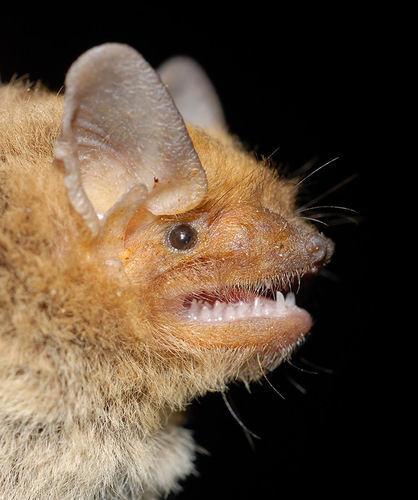
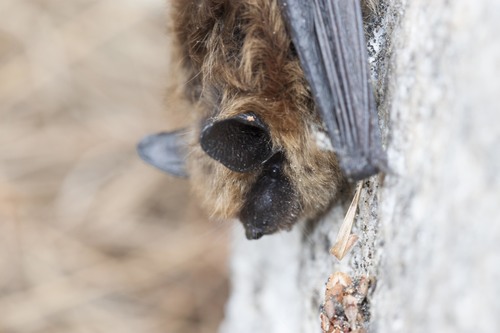
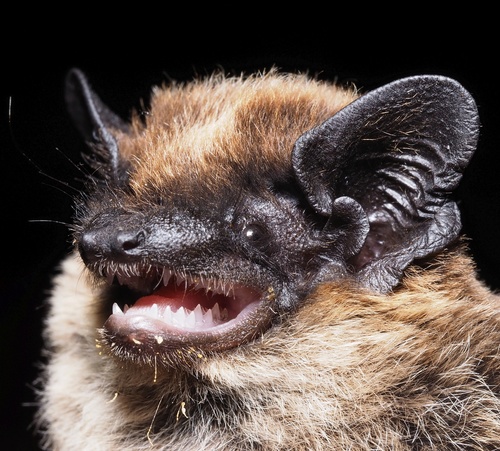
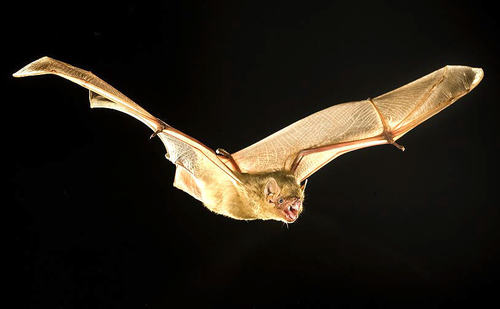
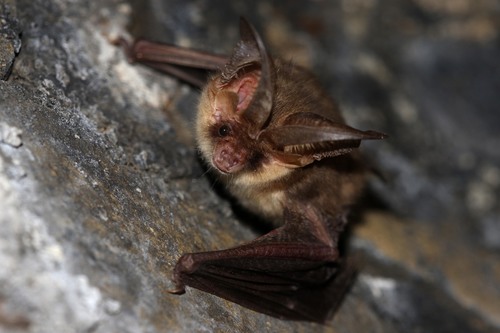
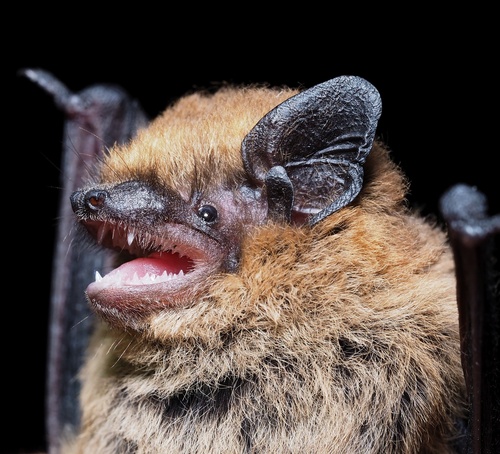
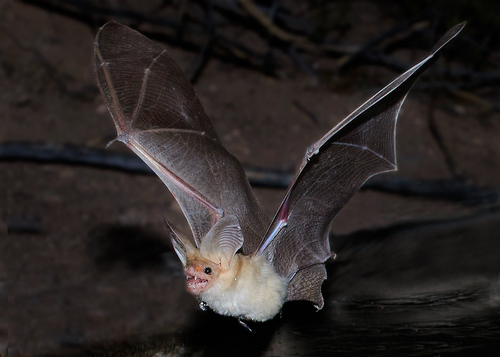
This species is Antrozous pallidus, the pallid bat. Pallid bats have a head and body length of approximately 2.75 inches (6.2 to 7.9 cm), a forearm length of approximately 2.1 inches (4.5 to 6 cm), a tail of approximately 1.75 inches (3.9 to 4.9 cm), and a wingspan of 15 to 16 inches (38 to 40 cm). They weigh between 14 and 25 grams. These are large bats, with long forward-pointing ears that measure over 2.5 cm. Their fur is pale at the roots, brown on the back, and has a light-colored underside. Pallid bats have a blunt, piglike snout. Their dental formula is 1.1.1.3 / 2.1.2.3 × 2 = 28. The bacula (penis bones) of pallid bats are wedge or spade-shaped. They generally have a short narrow base that widens, then tapers toward the tip. The bone also has a characteristic downward dip around its midpoint, with a raised base and raised tip. Pallid bats are typically found in arid or semi-arid habitats, often in mountainous or rocky areas located near water. They also live over open, sparsely vegetated grasslands. During the day, pallid bats typically roost in cracks and crevices, which can include tile roofs, exfoliating tree bark, or rocky outcrops. During the night, this species often uses a night roost that is closer to its foraging grounds than its day roost. A night roost is usually less protected than a day roost, and open porches may be used as night roosts by this species. In the winter, this species may enter short shallow bouts of torpor, most often in buildings, caves, or rock cracks. Pallid bats are insectivores that feed on arthropods such as crickets, and are capable of consuming up to half their body weight in insects every night. Pallid bats are prey gleaners: they capture prey from the ground and transport it to their night roost to eat. When foraging, pallid bats typically fly at low heights of 1 to 2 meters off the ground. Most notably, pallid bats consume Arizona bark scorpions, which are the most venomous scorpions in North America, and their stings can be fatal to humans. Pallid bats have been found to carry one or more missense mutations that substitute amino acids in their voltage-gated sodium channels, which may be responsible for their resistance to scorpion venom. Although pallid bats are primarily insectivores, they show some flexibility in their diet: they seasonally feed on nectar from Mexican columnar cacti, particularly cardón cactus, in spring, and even eat cactus fruit in summer. Pallid bats are also more effective pollinators than some of the nectarivorous bat species they compete with for access to cacti. Like many other bat species, pallid bats are heterothermic, which means they can be either poikilothermic or homoeothermic depending on the time of year. They have the ability to control their body temperature and equilibrate it with the environment during winter hibernation and whenever they rest. Pallid bat size varies greatly depending on habitat. Bats in areas with low primary productivity, such as deserts, tend to be smaller due to lower resource availability. Bats that live in areas with higher primary productivity, such as coastal regions, tend to be larger. Larger pallid bats also have crania that allow them to eat larger, harder prey more easily.