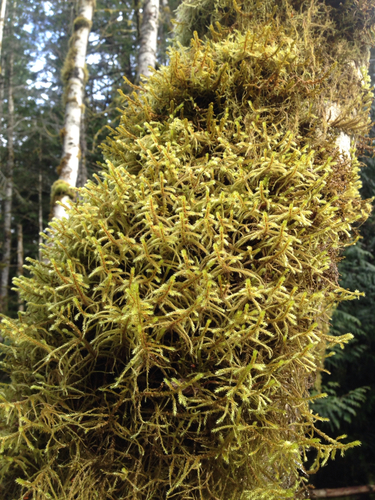
About Antitrichia curtipendula (Hedw.) Brid.
Antitrichia curtipendula, commonly called hanging moss, has dark red stems and green leaves, which give the entire mat of intertwined stems a rusty yellow appearance. The intensity of this color changes based on how much moisture the organism holds. Stems can grow 15 to 30 cm long, and each leaf has three midribs when examined closely: one longer main midrib running down the center, and two shorter, fainter midribs on either side. This leaf trait distinguishes it from similar epiphytes such as Rhytidiadelphus loreus, also known as lanky moss. Antitrichia curtipendula grows higher in forest canopies than many other mosses, and forms large clumps on tree branches, tree trunks, and stumps that look like a cross between a blanket and a carpet. As an epiphyte, it is not parasitic, so it does not cause damage to the host plant it grows on. The host only provides structural support and a raised position that helps the moss access the nutrients it needs to grow. Hanging moss does not grow roots into the ground; instead, it develops complex root systems on its host that weave together into a tight mat, which provides structure and support for the entire moss community. Growing above the forest floor lets these epiphytes access precipitation that falls through the canopy. Like other plants, epiphytes perform photosynthesis to get energy from sunlight, and growing in the canopy gives them access to more sunlight than they would receive on the forest floor. They get both water and nutrients directly from the air, so they do not need to grow roots into soil. Antitrichia curtipendula is a small, flowerless, seedless plant that reproduces via spores, and it prefers shady environments that maintain consistent moisture. After spore germination during early development, moss grows into a thin, felt-like structure on damp soil, rocks, or tree bark. This transitional life cycle stage leads to the growth of a gametophore, which then develops into mature stems and leaves. Wind plays an important role in distributing the moss's spores. Since this moss does not grow on the forest floor, spores cannot simply fall to the ground and take root. Wind dispersal lets spores reach greater distances than they would otherwise, and helps them reach and attach to canopy surfaces. Insects and birds also contribute to the reproduction of epiphytes like hanging moss, alongside wind. When birds or insects land on or brush against the moss, they can pick up spores on their bodies and carry these spores through the forest to new locations. This process can spread moss spores even farther than wind dispersal alone.

