About Antirrhinum litigiosum Pau
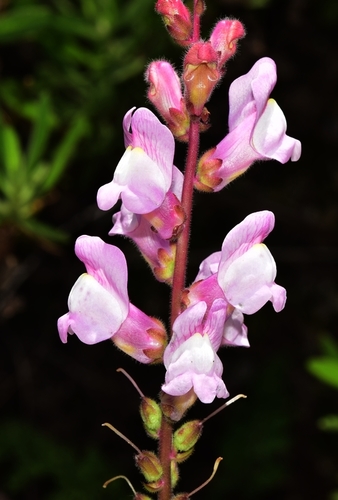
Antirrhinum barrelieri is a perennial herbaceous plant in the common snapdragon genus Antirrhinum, belonging to the family Plantaginaceae. It grows in an overall subshrub form. This species produces thick aerial stems that grow between 30 cm (12 in) and 75 cm (30 in) tall. Each stem branches extensively, and is glabrous (hairless) at mid-height, while light hairiness (pubescence) occurs at the stem base and on the terminal inflorescences. Narrow leaves grow along the stems, measuring 10 mm (0.39 in) to 50 mm (2.0 in) long and 1.5 mm (0.059 in) to 5 mm (0.20 in) wide. At the base of the stem, leaves are arranged in opposite pairs; further up the stem, leaves are arranged in an alternating pattern. Leaf shapes range from linear to narrowly lanceolate. The upper surface of each leaf is green, while the lower surface is purple; this two-toned leaf color is typical for Antirrhinum species. Flowers grow in terminal inflorescences at the end of each stem, as is characteristic of the Antirrhinum genus. Each flower has five unequal-sized sepals forming a deeply cleft calyx. The overall flower corolla is shaped like an open tube. A single A. barrelieri plant produces 8 to 20 pink or purplish flowers. Each flower grows from a pedicel that measures 6 mm (0.24 in) to 30 mm (1.2 in) long. The flower corolla is typically 25 mm (0.98 in) to 35 mm (1.4 in) in diameter, and becomes whitish toward the base of the corolla tube. In its native range, this species flowers and fruits from March to September, with occasional marginal observations extending into December. Fruiting produces oblong-ovoid capsules that measure 10 mm (0.39 in) to 15 mm (0.59 in) long and 8 mm (0.31 in) to 11 mm (0.43 in) wide. These capsules have woody walls covered in glandular hairs up to 0.6 mm (0.024 in) long. The seeds are black and oblong-ovoid, measuring 0.6 mm (0.024 in) to 0.8 mm (0.031 in) long. The native range of Antirrhinum barrelieri is limited to northeastern Spain. It grows best in a subtropical climate, and has the morphological adaptations typical of grassland species within the Antirrhinum subsection of the genus. In its native range, it grows at elevations from sea level up to 1,500 m (4,900 ft). A population once described as A. barrelieri occurs in Morocco, named for its morphological similarity to Sierra Nevada populations now accepted as A. controversum. However, a 2021 genetic analysis of Mediterranean Antirrhinum populations found the Moroccan population previously called A. barrelieri is more closely related to Antirrhinum tortuosum from Sierra de Grazalema, located across the Strait of Gibraltar in Spain.