About Antilope cervicapra (Linnaeus, 1758)
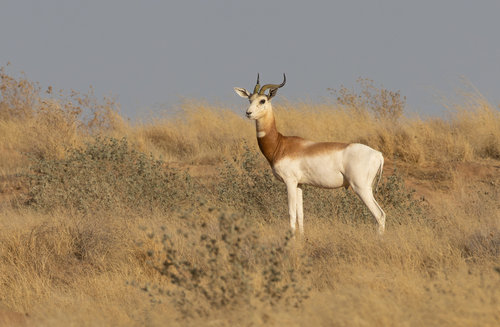
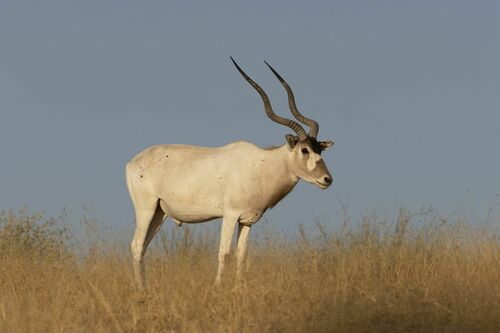
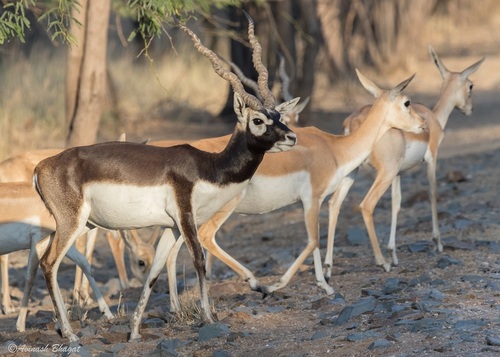
The blackbuck (Antilope cervicapra) has white fur on its chin and around the eyes, which contrasts sharply with black facial stripes. Male blackbucks have two-toned coats: their upper bodies and the outer sides of their legs are dark brown to black, while their underparts and the inner sides of their legs are entirely white. A male’s coat typically grows darker as he ages. Females and juveniles have yellowish fawn to tan colored coats. In Texas, blackbucks moult in spring, after which males look noticeably lighter, though dark color remains on their face and legs. Conversely, males grow darker as the breeding season approaches. Both melanism and albinism have been recorded in wild blackbuck; albino blackbuck are often popular attractions at zoos, such as Indira Gandhi Zoological Park. The blackbuck is a moderately sized antelope. It stands 74 to 84 cm (29 to 33 in) high at the shoulder, with a total head-to-body length of around 120 cm (47 in). Among the introduced population in Texas, males weigh 20–57 kg (44–126 lb), with an average weight of 38 kg (84 lb). Females are lighter, weighing 20–33 kg (44–73 lb), with an average weight of 27 kg (60 lb). Sexual dimorphism is very noticeable: males are heavier and darker than females. Long, ringed, corkscrew-shaped horns are generally found only on males, though females can sometimes develop horns. Horns measure 35–75 cm (14–30 in) overall; the maximum recorded horn length from Texas individuals does not exceed 58 cm (23 in). The horns diverge to form a V-shape. In India, individuals from the northern and western parts of the country have longer, more divergent horns than other populations. Blackbucks are very similar in appearance to gazelles, and can be mainly distinguished by the color of their dorsal parts: gazelles are brown here, while blackbuck have dark brown or black dorsal coloration. The blackbuck is native to the Indian subcontinent, where it inhabits grassy plains and thinly forested areas that have access to perennial water sources, which the species needs to drink from daily. Herds will travel long distances to reach water. British naturalist William Thomas Blanford described the blackbuck’s range in his 1891 work The Fauna of British India, including Ceylon and Burma as covering India from the base of the Himalayas to the area around Cape Comorin (Point Calimere is the southernmost locality he recorded), and from the Punjab to Lower Assam, restricted to open plains. The species was not recorded in Ceylon, east of the Bay of Bengal, on hills, in thickly wooded areas, or anywhere along the Malabar coast south of the area around Surat. The claim that blackbuck do not occur in Lower Bengal is not entirely accurate: none live in the swampy Gangetic delta, but many are found on the plains near the coast in Midnapore (Blanford noted having shot individuals near Contai), and also in Orissa. Blackbucks were most abundant in the North-west Provinces, Rajputana, and parts of the Deccan, and were locally distributed only within specific areas. Today, small scattered herds are mostly limited to protected areas. In Pakistan, blackbuck occasionally occurred along the Indian border until 2001, and the species is now considered locally extinct in Pakistan and Bangladesh. In southern Nepal, the last surviving blackbuck population in the Blackbuck Conservation Area was estimated at 184 individuals in 2008. A small number of blackbuck also live on the campus of the Indian Institute of Technology Madras. The blackbuck is a diurnal antelope, though it is less active at midday when summer temperatures rise. It can run at speeds up to 80 kilometres per hour (50 mph). Herd size varies, and appears to depend on forage availability and habitat type. Large herds have an advantage over smaller herds because danger can be detected more quickly, though individual herd members show lower vigilance than in small herds. Large herds also spend more time feeding than small herds. A disadvantage of large herds is that traveling requires more energy resources. Herd size decreases in summer. Males commonly use a lekking strategy to access females for mating. Males establish territories based on the local distribution of female groups, which is determined by habitat, to secure greater access to females. Males actively defend resources within their territories, which are between 1.2 and 12 hectares (3.0 to 29.7 acres; 0.0046 to 0.0463 sq mi) in size. Territories are scent-marked using secretions from the preorbital and interdigital glands, as well as faeces and urine. Other males are not allowed to enter these territories, but females are permitted to visit to forage, and males can attempt to mate with visiting females. Lekking is physically demanding, and males often sustain injuries during competition, so this tactic is typically used only by strong, dominant males. Males may either guard their mates or attempt to forcibly copulate with them; weaker, non-dominant males typically choose the latter approach. Blackbuck populations are severely impacted by natural disasters such as floods and droughts, and can take up to five years to recover from these events. Wolves are major predators of blackbuck, and old rutting bulls are especially vulnerable prey. Golden jackals hunt blackbuck juveniles, and village dogs have been reported to kill blackbuck fawns, though they rarely successfully hunt and kill adult blackbuck. In Great Indian Bustard Sanctuary, blackbuck show flexible habitat use that shifts seasonally as resource availability and predation risk change across the landscape. They use small patches within an area of roughly 3 km2 (1.2 sq mi). Human activities strongly affect herd movement, but the presence of small refuges allows blackbuck to persist in the landscape. Females reach sexual maturity at eight months old, but do not mate until they are at least two years old. Males mature at one and a half years old. Mating can occur throughout the year, with peaks in spring and fall in Texas. Two mating peaks are observed in India: from August to October, and from March to April. Rutting males aggressively establish and defend their territories against other males, producing loud grunts and engaging in intense head-to-head fights where they push against each other with their horns. Aggressive displays involve thrusting the neck forward and raising it, folding the ears, and raising the tail. A dominant male pursues a female with his nose pointing upward, smells her urine, and displays a flehmen response. A receptive female signals her status by waving her tail and thumping her hindlegs on the ground. This is followed by multiple mounting attempts and then copulation. The entire mating process can last up to six hours. The female remains still for some time after copulation, before beginning to graze, and the male will then leave to mate with other females. Gestation typically lasts six months, after which a single calf is born. Newborns are light yellow; infant males may have a black patch on the head and neck. Blackbuck young are precocial, and can stand on their own shortly after birth. Females are able to mate again one month after giving birth. Juveniles remain active and playful throughout the day. Juvenile males darken gradually, turning notably darker after their third year. The typical lifespan of a blackbuck is 10 to 15 years.