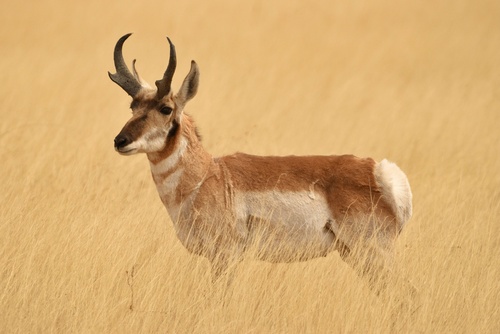
About Antilocapra americana (Ord, 1815)
Scientific name: Antilocapra americana (Ord, 1815)
Pronghorns have distinct white fur on their rumps, sides, breasts, bellies, and across their throats. Adult males measure 4.3–4.9 ft (1.3–1.5 m) from nose to tail, stand 2.7–3.4 ft (82–104 cm) high at the shoulder, and weigh 88–143 lb (40–65 kg). Females are the same shoulder height as males, but weigh 75–106 lb (34–48 kg). Pronghorn feet have two hooves and no dewclaws, and their body temperature is 100 °F (38 °C).
Before Europeans arrived, pronghorn were especially abundant in regions west of the Mississippi River, which remains their primary range today. The prehistoric American Prairie, as recently as 200 to 300 years ago, was called the "American Serengeti" for its enormous herds of millions of bison, elk, and pronghorn alongside many other now-extinct megafauna. Their current range lies west of the Mississippi, stretching from southern Saskatchewan and Alberta, Canada, south into the western United States (primarily the states of Arizona, Colorado, Idaho, Kansas, Montana, Nebraska, Nevada, New Mexico, North Dakota, Oklahoma, Oregon, South Dakota, Texas, Utah, Washington, and Wyoming), and continues into Mexico. In extreme Northern California, pronghorn live in inland counties extending in from neighboring Nevada and Oregon, as well as further south in central coastal grasslands. In Mexico, the subspecies Sonoran pronghorn (A. a. sonoriensis) occurs from the state of Baja California Sur east through Sonora to San Luis Potosí, in the country's north-central regions, with populations that are gradually decreasing. Pronghorn have been completely extirpated from Iowa and Minnesota in the United States, and from Manitoba in Canada. Other recognized regional subspecies are the Rocky Mountain pronghorn (A. a. americana), Mexican pronghorn (A. a. mexicana), Oregon pronghorn (A. a. oregona), and the critically endangered Baja California pronghorn (A. a. peninsularis).
Pronghorn prefer open terrain at elevations between 3,000 and 5,900 ft (910 and 1,800 m), and the densest populations occur in areas that get around 10–16 in (254–406.5 mm) of rainfall per year. They eat a wide variety of plant foods, and often consume plants that are unpalatable or toxic to domestic livestock, though they also compete with domestic livestock for food. One study found forbs made up 62% of their diet, shrubs 23%, and grasses 15%. A separate study recorded similar overall forage use, with forbs at 20%, cacti at 40%, shrubs at 18%, and grass at 22%. Pronghorn are ruminants that chew cud. Healthy pronghorn populations generally stay within 3–4 mi (5.0–6.5 km) of a water source, and most individuals are found within 5 mi (8 km) of a water source. An ongoing study by the Lava Lake Institute for Science and Conservation and the Wildlife Conservation Society has documented an overland migration route for pronghorn that spans more than 160 mi (260 km). Migrating pronghorn travel from the foothills of the Pioneer Mountains through Craters of the Moon National Monument to the Continental Divide. Dr. Scott Bergen of the Wildlife Conservation Society stated "This study shows that pronghorns are the true marathoners of the American West. With these new findings, we can confirm that Idaho supports a major overland mammal migration - an increasingly rare phenomenon in the U.S. and worldwide."
Major predators of pronghorn include cougars (Puma concolor), wolves (Canis lupus), coyotes (Canis latrans), grizzly bears (Ursus arctos horribilis), and bobcats (Lynx rufus). Golden eagles (Aquila chrysaetos) have been recorded preying on both fawns and adult pronghorns. Jaguars (Panthera onca) also likely prey on pronghorn within the jaguar's native range in the southwestern United States and northern Mexico; during the Pleistocene, jaguars were likely dangerous to pronghorn as short-range ambush predators.
In winter, pronghorn form mixed-sex herds. In early spring, these herds split apart: young males form bachelor groups, females form harems, and adult males live alone. Some female groups share the same summer range, and bachelor male groups exist from spring through fall. Females form dominance hierarchies with few circular relationships, and dominant females will aggressively push other females away from feeding sites.
Adult pronghorn males use one of two mating strategies: they either defend a fixed territory that females may enter, or defend a harem of females. An individual male may change his mating strategy based on environmental or demographic conditions. Where precipitation is high, adult males tend to hold territories, and maintain these areas through scent marking, vocalization, and challenging intruding males. In these systems, territorial males have access to better resources than bachelor males.
Females also use different mating strategies. "Sampling" females visit several males, staying with each for only a short time before switching to the next, and increase the rate of switching as they approach estrus. "Inciting" females behave like sampling females until estrus begins, then provoke conflicts between males, watch the fights, and mate with the winner. Before fighting, males first attempt to intimidate each other; if intimidation does not work, they lock horns and try to injure one another. "Quiet" females stay with a single male in an isolated area for the entirety of estrus. Females maintain this mating behavior for two to three weeks.
When courting an estrus female, a male pronghorn approaches while vocalizing softly and waving his head from side to side to display his cheek patches. Pronghorn have scent glands on either side of the jaw, between the hooves, and on the rump. A receptive female will stay motionless, sniff the male's scent gland, and then allow the male to mount her. Pronghorn have a gestation period of 7–8 months, which is longer than is typical for North American ungulates. They breed in mid-September, and does carry their fawns until late May. This gestation period is around six weeks longer than that of the white-tailed deer. Females usually give birth within a few days of one another, and twin fawns are common. Newborn pronghorn weigh 4–9 lb (2–4 kg), most commonly 7 lb (3 kg). In their first 21–26 days of life, fawns spend most of their time hiding in vegetation. Fawns only interact with their mothers for 20–25 minutes a day, and this schedule continues even after the fawn joins a nursery group. Females nurse, groom, and lead their young to food and water, and keep predators away from their young. Females usually nurse their young about three times a day. Male fawns are weaned 2–3 weeks earlier than female fawns. Pronghorn reach sexual maturity at 15 to 16 months old, though males rarely breed until they are three years old. Their typical maximum lifespan is 10 years, and individuals rarely live to 15 years.

