About Antidorcas marsupialis (Zimmermann, 1780)
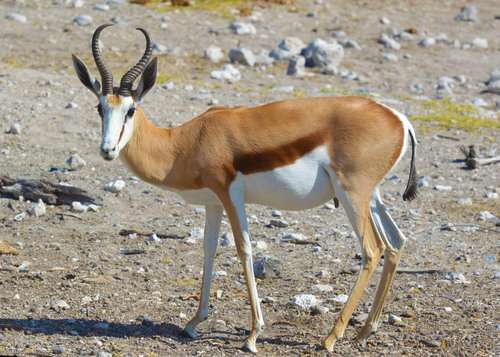
The springbok (Antidorcas marsupialis) is a slender antelope with long legs and a long neck. For both sexes, shoulder height ranges from 71 to 86 cm (2 ft 4 in – 2 ft 10 in), head-and-body length typically falls between 1.2 and 1.5 m (3 ft 11 in – 4 ft 11 in), and body weight ranges from 27 to 42 kg (60 – 93 lb). Its 14 to 28 cm (5.5 – 11.0 in) long tail ends in a short black tuft. The three recognized subspecies differ noticeably in size and weight. For A. m. angolensis, males stand 84 cm (33 in) tall at the shoulder and weigh around 31 kg (68 lb), while females stand 81 cm (32 in) tall and weigh around 32 kg (71 lb). A. m. hofmeyri is the largest subspecies: males are nearly 86 cm (2 ft 10 in) tall and weigh 42 kg (93 lb), while females are a notably shorter 71 cm (2 ft 4 in) tall and weigh 35 kg (77 lb). A. m. marsupialis is the smallest subspecies: males are 75 cm (2 ft 6 in) tall with an average weight of 31 kg (68 lb), and females are 72 cm (2 ft 4 in) tall with an average weight of 27 kg (60 lb). One study found a strong correlation between winter dietary protein availability and springbok body mass. Springbok have distinct facial markings: dark stripes run across the white face from the corner of each eye to the mouth, and a dark patch marks the forehead. In juvenile springbok, these stripes and patch are light brown. Their narrow, pointed ears measure 15 to 19 cm (5.9–7.5 in) long. The typical springbok coat is light brown, with a dark reddish-brown horizontal band running from the upper foreleg to the edge of the buttocks, which separates the dark back from the white underbelly. The tail (except the terminal black tuft), buttocks, inner legs, and rump are all white. Two pure color variants, pure black and pure white, have been artificially selected on some South African ranches. Black springbok are born with a deep black sheen; adult black springbok are two shades of chocolate-brown and develop a white facial marking as they mature. White springbok are predominantly white, with a light tan stripe on the flanks. The three subspecies also differ in coloration. A. m. angolensis has a brown to tawny coat, with thick dark brown facial stripes that extend two-thirds of the way down to the snout. Its lateral stripe is nearly black, its rump stripe is dark brown, and its medium brown forehead patch extends to eye level, separated from the bright white face by a dark brown border. A brown spot is visible on the nose. A. m. hofmeyri has a light fawn coat, with thin dark brown facial stripes. Its flank stripes are dark brown to black, its posterior stripes are moderately brown, and its dark brown or fawn forehead patch extends past eye level and blends into the white face with no clear border. The nose may have a pale smudge. A. m. marsupialis has a rich chestnut brown coat, with thin, light facial stripes. Its rump stripe is well-marked, and its flank stripe is deep brown. The forehead patch can be brown, fawn, or white, does not extend past the eyes, and has no sharp boundaries. The nose is either white or marked with brown. Along the middle of the springbok's dorsal side, the skin is folded inward and covered with 15 to 20 cm (5.9 to 7.9 in) of white hair that can be erected by arrector pili muscles between hair follicles. This white hair is almost entirely hidden by surrounding brown hairs until the skin fold opens, and this feature is a key distinction between springbok and gazelles. Springbok differ from gazelles in several other ways: unlike gazelles, which have three premolars on each side of each jaw, springbok have two premolars on each side of each jaw, giving springbok a total of 28 teeth compared to 32 in gazelles. Springbok also have a longer, broader, more rigid nasal bridge, more muscular cheeks, and different horn structure than gazelles. Both sexes have black horns 35–50 cm (14–20 in) long that are straight at the base and curve backward. In A. m. marsupialis, females have thinner horns than males, and female horns are only 60 to 70% as long as male horns. Horn base girth ranges from 71–83 mm (2.8–3.3 in), thinning to 56–65 mm (2.2–2.6 in) toward the tip. In the other two subspecies, the horns of males and females are nearly similar. The springbok's narrow, sharp spoor is 5.5 cm (2.2 in) long. Springbok live in dry areas of south and southwestern Africa. Their current range extends from northwestern South Africa through the Kalahari Desert into Namibia and Botswana, with the eastern edge of their range at Transvaal; from there the range extends west to the Atlantic and north to southern Angola and Botswana. In Botswana, springbok occur mostly in the Kalahari Desert in the southwestern and central parts of the country. They are widespread across Namibia, the vast grasslands of the Free State, and the shrublands of Karoo in South Africa, and are confined to the Namib Desert in Angola. The historic range of the springbok stretched across the dry grasslands, bushlands, and shrublands of south-western and southern Africa, and springbok migrated sporadically in southern parts of this range. These migrations are rarely seen today, but seasonal congregations can still be observed in preferred areas of short vegetation like the Kalahari Desert. Springbok are mainly active at dawn and dusk. Their activity patterns change with the weather: they may feed at night during hot weather, and at midday during colder months. They rest in the shade of trees or bushes, and often bed down in the open when the weather is cooler. The social structure of the springbok is similar to that of Thomson's gazelle. Mixed-sex herds or harems have a roughly 3:1 sex ratio, and solitary bachelors also exist. During the mating season, males generally form herds and wander to search for mates. Females live with their offspring in herds that very rarely include dominant males. Territorial males round up female herds that enter their territories and keep out bachelors; mothers and juveniles may gather in nursery herds separate from harem and bachelor herds. After weaning, female juveniles stay with their mothers until the birth of the mother's next calf, while male juveniles join bachelor groups. Studies of herd vigilance behaviour show that individuals on herd borders are more cautious, and overall vigilance decreases as group size increases. Group size and distance from roads and bushes have a major influence on vigilance, with a stronger effect on grazing springbok than browsing springbok. Adults are more vigilant than juveniles, and males are more vigilant than females. Springbok moving through bushes are more vulnerable to predator attacks, as predators often conceal themselves in bushes and springbok cannot easily receive alert signals there. One study calculated that springbok on the edges of herds spend roughly double the time on vigilance compared to springbok in the centre or in open areas. Springbok are more cautious in the late morning than at dawn or the afternoon, and more cautious at night than during the day. Vigilance rates and methods vary to reduce predation risk. During the rut, males establish territories of 10 to 70 hectares (25 to 173 acres), which they mark by urinating and leaving large piles of dung. Males in neighbouring territories frequently fight for access to females by twisting and levering at each other with their horns, interspersed with stabbing attacks. Females roam across the territories of multiple males. Outside the rut, mixed-sex herds can range from as few as three to as many as 180 individuals, while all-male bachelor herds typically hold no more than 50 individuals. Harem and nursery herds are much smaller, typically including no more than 10 individuals. In earlier times, when large springbok populations roamed the Kalahari Desert and Karoo, millions of migrating springbok formed herds hundreds of kilometres long that could take several days to pass a town. These large mass treks, called trekbokking in Afrikaans, occurred during long periods of drought. Herds could efficiently retrace their paths to their original territories after long migrations. Trekbokking is still occasionally observed in Botswana, though on a much smaller scale than in the past. Springbok often perform repeated high leaps of up to 2 m (6 ft 7 in) into the air, a behaviour called pronking or stotting. During pronking, the springbok makes multiple leaps into the air with a stiff-legged posture, bowed back, and the white dorsal flap lifted. When a male displays his strength to attract a mate or ward off predators, he starts with a stiff-legged trot, leaping into the air with an arched back every few paces and lifting the dorsal flap along his back. Lifting the flap causes the long white hairs under the tail to stand up in a conspicuous fan shape, which releases a strong scent of sweat. Although the exact cause of pronking is unknown, springbok do this behaviour when they are nervous or otherwise excited. The most accepted theory is that pronking works to raise an alarm to other herd members against a potential predator, confuse the predator, or let the springbok get a better view of a concealed predator; it may also be used for courtship or strength display. Springbok are very fast antelopes, clocked at 88 km/h (55 mph). Carnivores generally tend to ignore springbok unless they are breeding. Major predators of adult springbok include cheetahs, lions, leopards, spotted hyenas, African wild dogs, caracals, crocodiles and pythons. Southern African wildcats, black-backed jackals, Verreaux's eagles, martial eagles, and tawny eagles target juvenile springbok. Springbok are generally quiet animals, though they may make occasional low-pitched bellows as a greeting and high-pitched snorts when alarmed. Springbok can mate year-round, though females are more likely to enter oestrus during the rainy season, when food is more plentiful. Females can conceive as early as six to seven months old, while males do not reach sexual maturity until two years old. The rut lasts 5 to 21 days. When a female approaches a rutting male, the male holds his head and tail level with the ground, lowers his horns, and makes a loud grunting noise to attract her. The male then urinates and sniffs the female's perineum. If the female is receptive, she also urinates; the male then makes a flehmen gesture and taps his leg until the female leaves or allows him to mate. Copulation consists of a single pelvic thrust. Gestation lasts five to six months, after which a single calf (rarely twins) is born. Most births occur in the spring, between October and November, before the rainy season begins. Newborn infants weigh 3.8 to 5 kg (8.4 to 11.0 lb). The female keeps her calf hidden in cover while she is away. Mother and calf rejoin the herd about three to four weeks after birth, and young are weaned at five or six months. When the mother gives birth again, her previous offspring, now 6 to 12 months old, leaves her to join adult springbok herds. This allows a female to give birth to calves twice a year, and even three times a year if one calf dies. Springbok can live up to 10 years in the wild.