About Anticlea elegans (Pursh) Rydb.
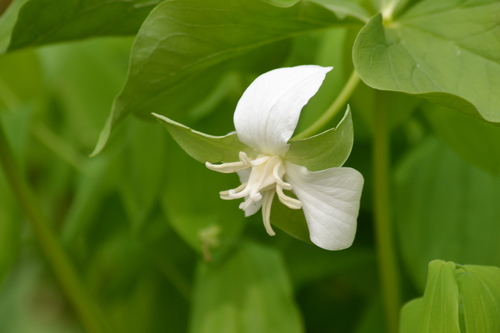
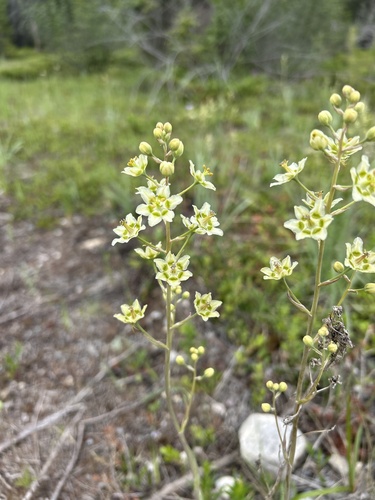
Anticlea elegans (Pursh) Rydb. produces white, lily-like flowers, with each petal bearing two-pronged, greenish-yellow heart-shaped glands; this gland shape helps distinguish the species from other members of its genus. Across the North American continent, western plants are generally smaller than eastern plants, but bear more densely clustered flowers. Its linear leaves are smooth in texture, and most grow from the base of the plant. Basal leaves average 1 to 2.5 cm (0.39 to 0.98 in) in length, with a maximum width of 15 mm (0.59 in). Very few leaves grow on flower stems; these leaves are reduced in size, and get smaller the further they are from the base of the stem up the stem. The fruits of this species are capsular, and measure 15 to 20 mm (0.59 to 0.79 in) long.
Overall, Anticlea elegans is widely distributed across western North America, but is not found in California or the southern southeastern United States. In Canada, its range stretches from Quebec and New Brunswick west to the Northwest Territories and Yukon, and extends into Alaska. The species follows the Rocky Mountains of western North America south through Arizona, New Mexico, and Texas, and continues along mountainous uplands into central Mexico. Three subspecies of Anticlea elegans are currently accepted. Anticlea elegans subsp. elegans is the most widely distributed of the three. Its northern range reaches into Alaska, Yukon, and the northern territories of western North America. In northeastern North America, this subspecies occurs across Manitoba, Ontario, and Quebec, but is absent from the eastern maritime provinces: Newfoundland, Labrador, New Brunswick, Nova Scotia, and Prince Edward Island. Along the St. Lawrence Seaway river system in Quebec, the range of A. elegans subsp. elegans overlaps with populations of A. elegans subsp. glauca; overlap also occurs in the upper Midwestern states of Iowa, Minnesota, and the Dakotas. Western North American populations of A. elegans subsp. elegans occur along the west coast from British Columbia south through Washington and Oregon, but are absent from California, the Baja California peninsula, and the Mexican west coast. Most southeastern populations of this subspecies are located in Nebraska, Colorado, New Mexico, and Texas.
The second most widespread subspecies is Anticlea elegans subsp. glauca, which grows along the St. Lawrence Seaway on both the Canadian and United States sides of the river system. In the Great Lakes region, this subspecies occurs south of the lakes, but is not found in Kentucky. It extends west through grasslands into North Dakota and South Dakota, and extends south along the Mississippi River into Iowa and Illinois. A number of relictual glacial refugia populations of A. elegans subsp. glauca have been identified in southeastern North America and New England. These populations occupy sites that were not glaciated, and provided habitat for boreal species displaced by advancing ice sheets. Relict populations are or were recorded in Missouri, Tennessee, Vermont, and West Virginia; however, the only known sites in both Tennessee and Vermont are thought to have been extirpated by the early 2000s. Seven populations are known in Missouri, spread across the Ozark Plateau, a region that hosts disjunct populations of at least 37 boreal plant species.
The rarest subspecies, Anticlea elegans subsp. vaginata, is restricted to rocky hanging garden biomes of the Colorado Plateau in Arizona, Colorado, and Utah. A. elegans subsp. elegans also occurs in this region, but grows in the mountainous forests that surround hanging garden habitats. Hanging gardens are ecological hotspots where perennial springs form in desert canyon wall alcoves, supporting year-round plant populations. All disjunct populations of A. elegans subsp. vaginata are found below 1,800 m (5,900 ft) elevation in hanging gardens with sandstone host rock. These plants usually grow in deeply shaded areas of spring alcoves.
In 2023, two alpine populations of Anticlea elegans in a Global Observation Research Initiative in Alpine Environments study area in Idaho's Lemhi Mountains were studied to assess pollinator ecology. Each population contained over 1000 plants covering 0.1–0.2 ha (11,000–22,000 ft²) above the tree line on flat, rocky mountain slope areas. The patches were monitored on July 31, 2023; flower visitors were captured, identified, recorded, and later deposited at the California Academy of Sciences. Researchers recorded nectaring by flies from at least four families: Calliphoridae (carrion flies), Fanniidae (house flies), Sarcophagidae (flesh flies), and Syrphidae (flower flies), with syrphids being the most common visitors. At least six syrphid species from the genera Chrysotoxum, Eristalis, Eupeodes, and possibly Dasysyrphus were identified during collection. During flower visits, the heads and upper surfaces of larger flies brush across stamens, collecting coatings of pollen that are then transported to other flowers, where contact with the stigma completes pollination. The flowers are also actively visited by unidentified small worker ants, which collect nectar from the tepals. Due to their small size, worker ants can reach nectaries in the flower centers without interacting with stamens or styles, so they do not facilitate pollination. Species of Osmia bees and Bombus bumble bees were also present in the alpine study area. During observation periods, these bees visited many other local plant species, but were not recorded visiting A. elegans. This indicates that flies, including flower flies, carrion flies, and flesh flies, are likely the major pollinators of A. elegans in alpine areas of Idaho. A separate subalpine study site at Webber Lakes in Idaho's Beaverhead Mountains, west of Yellowstone National Park, was surveyed on July 28, 2020. At this site, A. elegans flowers were dominated by Tenthredo species sawflies. Sawfly activity at the flowers was not limited to pollination; multiple mating pairs were observed, suggesting the flowers are a preferred trysting location for this sawfly genus.