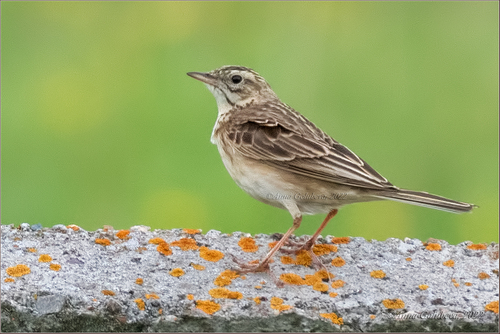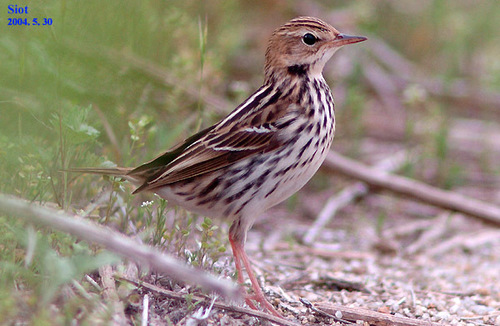
About Anthus spragueii (Audubon, 1844)
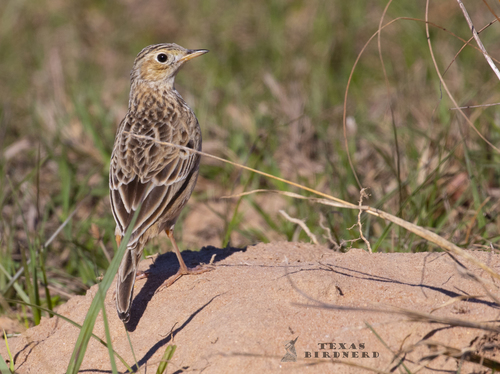
Anthus spragueii (Audubon, 1844), commonly called Sprague's pipit, has the following physical measurements: length 5.9–6.7 inches (15–17 cm), weight 0.6–0.9 ounces (18.2–27 g), and wingspan 10 inches (25.4 cm).
This species is found in mixed or short grass prairie across the central northern Great Plains of North America. Its breeding range includes southern Alberta, southern Saskatchewan, and southwest Manitoba in Canada; in the United States, breeding occurs in northeastern and central Montana, western and central North Dakota, northwest South Dakota, and the Red River Valley of Minnesota. Sprague's pipits winter in the southwestern United States and northern Mexico. In the United States, wintering populations range from casual occurrences in southern California, through south-central and southeastern Arizona, southern New Mexico, central and eastern Texas, and south through Arkansas and Louisiana; they are occasionally found in southern Kansas and southern Oklahoma, and very rarely in southern Missouri, Tennessee, and northwestern Mississippi. In October 2016, an individual was recorded in Connecticut for the first time, indicating the species may occur as a vagrant in other areas. In Mexico, the species is found in the interior from northeastern Sonora and Nuevo Leon south to Zacatecas and San Luis Potosi, and along the Atlantic Coast from Tamaulipas to central Veracruz; it is uncommon in the Central Volcanic belt, rare in western Tobasco, and a vagrant to southern Guerrero (Howell and Webb 1995).
For breeding, Sprague's pipit uses habitats with minimal human disturbance from activities such as grazing, haying, or other development. It is a ground-nesting passerine that uses standing dead vegetation to form a canopy over its nest. Breeding activity can start as early as late April and continues through mid to late August. Nests are small grass cups built on the ground, with standing dead vegetation folded over to form a canopy that has a single entrance. Clutches usually contain four to six eggs, with an average incubation period of 13–14 days. While renesting, second broods, and polygyny have been occasionally documented for this species, Sprague's pipits are predominantly single-brooded (Jones et al. 2010).