About Anthus spinoletta (Linnaeus, 1758)
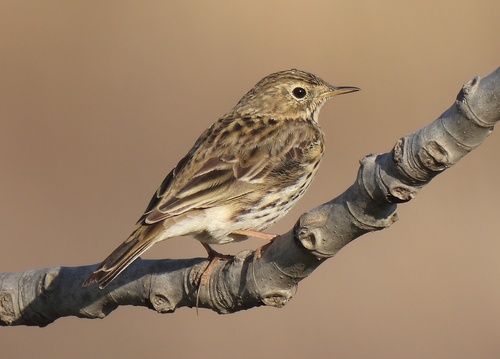
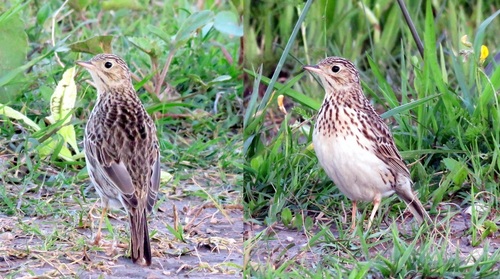
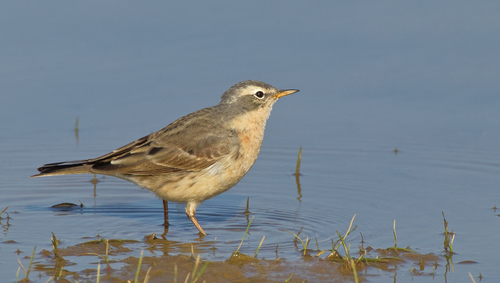
Anthus spinoletta, commonly called the water pipit, measures 15–17 centimetres (5.9–6.7 in) in length and weighs 18.7–23 grams (0.66–0.81 oz). For adult nominate race water pipits in spring breeding plumage, upperparts are greyish-brown, with faint darker brown streaking; underparts are pale pink-buff that fades to whitish on the lower belly. There may be faint streaking on the breast and flanks. The head is grey, marked with a broad white supercilium. Outer tail feathers are white, while the legs, bill, and iris are dark brown or blackish. In non-breeding plumage, the head is grey-brown, the supercilium is less distinct, upperparts are more heavily streaked, and underparts are white, with light brown markings on the breast and flanks. The sexes are similar in appearance, though on average females have a greyer head. Juvenile water pipits resemble non-breeding adults, but are browner, more heavily streaked on the upperparts, and have prominent streaking on the underparts. The subspecies A. s. coutellii is smaller than the nominate race, has a faint grey tint in the white of its outer tail feathers, is paler and more heavily streaked on the upperparts, and in summer plumage the coloured underpart area is larger and carries a rusty tint. The subspecies A. s. blakistoni is large, pale, and has less strong streaking. Water pipits undergo a complete moult between July and September, with substantial individual variation in the timing of this event. They also have a partial pre-breeding moult that occurs mainly between January and March, again with high timing variability. This pre-breeding moult typically replaces head, body, and some wing feathers, though the extent of the moult varies between individuals. Very rarely, females may moult into a plumage that resembles non-breeding plumage instead of the expected brighter breeding plumage. Chicks begin developing juvenile plumage as early as one month after hatching, and most have finished transitioning to a near-adult appearance by September. The first pre-breeding moult for young birds is similar to that of adults, but may be less complete or even absent entirely. The water pipit is closely related to the Eurasian rock pipit and the meadow pipit, and is quite similar in appearance to both. Compared to the meadow pipit, the water pipit has longer wings and a longer tail, much paler underparts, and dark legs instead of the meadow pipit's pinkish-red legs. Winter-plumage water pipits can be confused with Eurasian rock pipits, but water pipits have a prominent supercilium, greyer upperparts, and white outer tail feathers (instead of grey), and are typically much warier than Eurasian rock pipits. In the breeding season, European rock pipits and water pipits use completely separate habitats, and there is little overlap even outside of the nesting period. There is also little overlap in breeding territories with meadow pipits, though some overlapping territories where the two species coexist have been recorded since 1960. The subspecies Anthus petrosus littoralis of the European rock pipit, in summer plumage, is especially similar in outward appearance to the water pipit. Rock pipits normally have a bluer tint to the head, streaking on the breast and flanks, and buff outer tail feathers, and their songs are also different from those of the water pipit. Even when the species occur in the same general area, they mostly occupy different habitat types. The water pipit's breeding range covers mountains of southern Europe and Asia, extending from Spain to central China, and includes the Mediterranean islands of Sardinia and Corsica. During the breeding season, the water pipit is predominantly a mountain species, found in alpine pasture and high meadows with short grass and scattered bushes or rocks. It typically occurs close to wetter areas and often on slopes. It breeds at altitudes between 615–3,200 metres (2,020–10,500 ft), mostly between 1,400–2,500 metres (4,600–8,200 ft). It migrates relatively short distances in autumn to lower elevation ground, and typically winters on coastal wetlands, marshes, rice fields, and similar open wet habitats. While most birds move to lowlands, some may remain at elevations up to 2,000 metres (6,600 ft). The nominate subspecies A. s. spinoletta winters mainly in western and southern Europe and northwestern Africa; in western Europe, some individual birds show fidelity to the same wintering site, returning each year. Birds breeding in Spain appear to only move lower down the mountains where they breed, rather than migrating longer distances. The subspecies A. s. coutellii winters at lower altitudes near its breeding ranges, and also in the Arabian Peninsula and northeast Africa. The subspecies A. s. blakistoni winters in Pakistan, northwest India, and southern China. Water pipits depart their breeding sites starting in mid-September, though eastern subspecies may begin moving south earlier than this. Spring migration starts in February and March, with birds arriving on breeding grounds in April and May. The water pipit has been recorded as a vagrant in Belarus, Gibraltar, and Latvia, and on islands including the Canaries, Iceland, Malta, and Svalbard.