About Anthus rufulus Vieillot, 1818
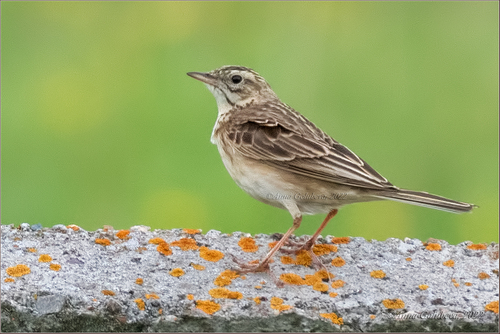
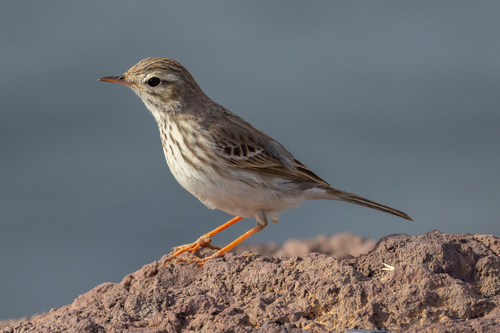
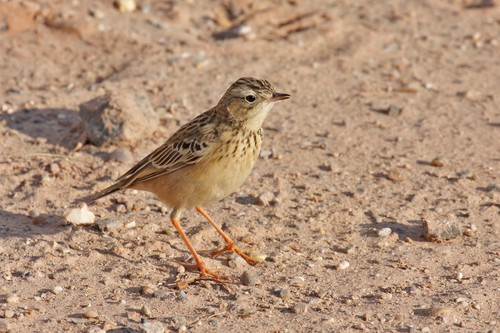
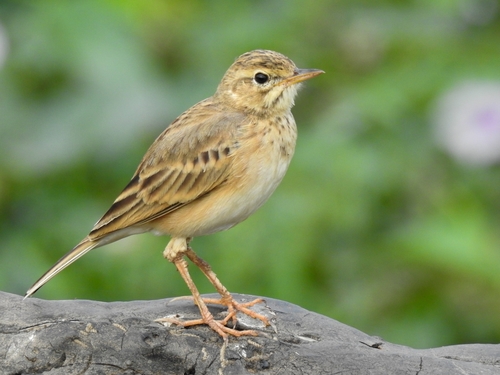
This species is a large pipit, measuring 15 cm in length, and is otherwise an undistinguished-looking bird. It is mainly streaked grey-brown on its upperparts, and pale below with breast streaking. It has long legs, a long tail, and a long dark bill. The sexes are similar in appearance, and summer and winter plumages are also similar. Young birds are more richly coloured on their underparts than adults, have more conspicuous pale edges to the upperpart feathers, and more prominent breast spotting. The waitei population found in north-western India and Pakistan is pale, while the malayensis population from the Western Ghats is larger, darker, and more heavily streaked; the nominate rufulus subspecies is intermediate between these two. In winter, care is needed to distinguish this species from other pipits that winter in the same area, such as Richard's pipit (Anthus richardi) and Blyth's pipit (Anthus godlewskii). Compared to those two species, the paddyfield pipit is smaller and dumpier, has a shorter-looking tail, and weaker fluttering flight. Its characteristic, commonly uttered chip-chip-chip call is quite different from the typical calls of Richard's pipit (an explosive shreep) and Blyth's pipit (a nasal pschreen). The tawny pipit has less streaking on the mantle, a black loreal stripe, and a longer tail. The Western Ghats population of this species can appear very similar to the Nilgiri pipit. This is a widespread species found in open habitats, especially short grassland and cultivated areas with open bare ground. It runs rapidly on the ground, and does not fly far when flushed. The paddyfield pipit breeds throughout the year, but mostly in the dry season. Individuals may raise two or more broods in a single year. During the breeding season, it sings by repeating a note as it descends from a short fluttery flight a few feet above the ground. It builds its nest on the ground under a slight raised feature, a tuft of grass, or at the edge of a bush. The nests are woven from grass and leaves, and are normally cup-shaped. Exposed nests are sometimes domed or semi-domed, with long grass from the back and sides extending over the top of the nest. Nests are lined with finer grass or roots, and sometimes have a small amount of dry moss, bracken, or other material at the base. The usual clutch size is three or four eggs, which have a greenish base colour and numerous small brown specks at the larger end. When disturbed near the nest, the birds flutter nearby while giving weak tsip-tsip-tsip calls. Parent birds may also feign injury to distract predators away from the nest. Mites are known to cause scaly leg lesions in this species. It feeds principally on small insects, but also eats larger beetles, tiny snails, and worms while walking on the ground, and may chase flying insects such as mosquitoes or termites in the air. A species of Haemoproteus, H. anthi, has been described from this species.