About Anthus rubescens (Tunstall, 1771)
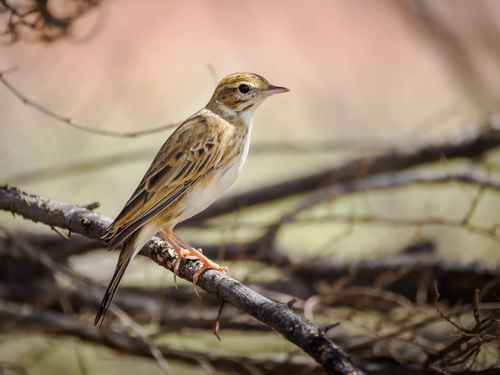
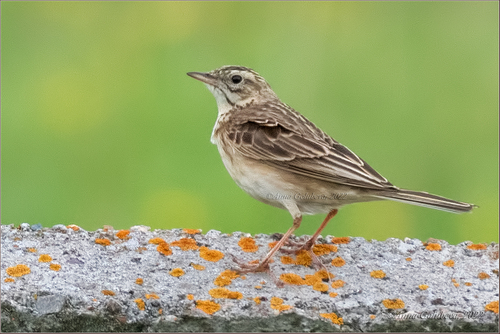
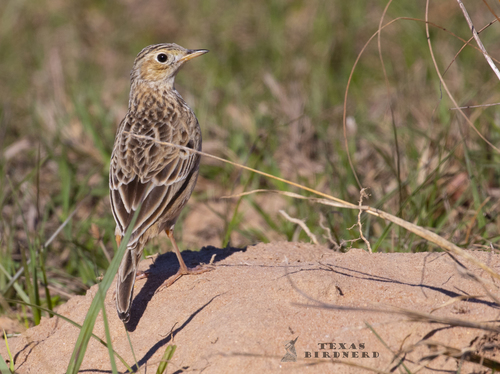
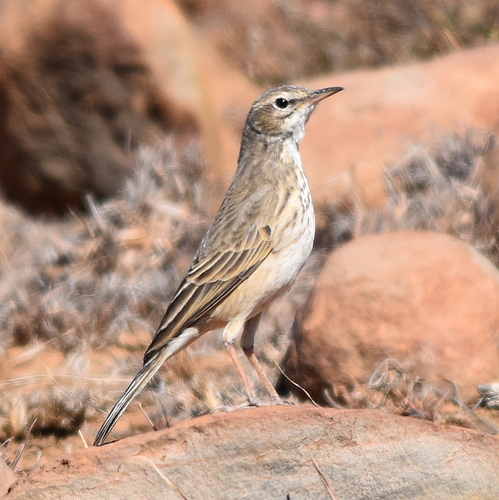
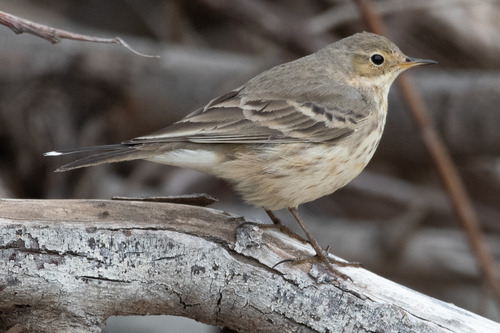
Like most other pipits, the American pipit (also called buff-bellied pipit, Anthus rubescens) is an undistinguished-looking species that is usually seen running along the ground. It has lightly streaked grey-brown upperparts, diffuse streaking on its buff breast and flanks, a whitish belly, and dark bill and legs. The closely related Siberian pipit is darker on the upperparts, has bolder black streaking on whiter underparts, and has reddish-hued legs. The call of the American pipit is a squeaky sip. Standard measurements for the species are: length 16 cm, weight 22 g, wingspan 24 cm. When American pipits arrive at their breeding sites during snowmelt, the first activity they complete is pairing. Males fight one-on-one to win a female, and form a pair bond that lasts the entire breeding season. They also fight to claim snow-free sites that offer better conditions for nesting. This timing is important because melting snow brings an increase in the abundance of arthropods, the main food source for these birds. After pairing and territorial disputes, nesting begins. Nests are almost always built on the ground in either dry or wet meadows, always positioned with some form of protective cover, and are never placed in shrubs or trees. The nest is built from whatever materials are available near the nesting site, but it is most commonly constructed from sedge, dried or fresh fine grass, and sometimes horse hairs. Nests of this species face a high risk of predation from a number of predators, including ants and hawks, which threatens nest success. If the nest survives predation, the female will produce eggs only if conditions like temperature and nesting site quality are optimal. If a first nesting attempt fails, the female has less remaining time to lay a replacement clutch. In general, American pipits lay eggs continuously over a 4 to 5 day period after snowmelt, which occurs between April and May, through to mid-July. After mid-July, male testes decrease in size, and females refuse to copulate. Clutch size is usually 5 eggs, but can vary based on snowfall, the reproductive ability of the parent birds, and predation pressure. Eggs are incubated for 13 to 14 days. During incubation, the female does not leave the nest, but reacts strongly to any movement near the nest. She communicates via song to the male, who brings her food and defends the pair's shared territory. Four or five days after hatching, the young hatchlings are skinny, blue-gray in color, and only have developed secondary feathers. For one week after hatching, the female broods the clutch, while both parents hunt to feed the young. After these 7 days, the young birds are ready for fledging, but they continue to be fed by their parents for 14 days after leaving the nest. Once they leave parental care, immature American pipits gather in small flocks with other immature individuals and disperse.