About Anthus richardi Vieillot, 1818
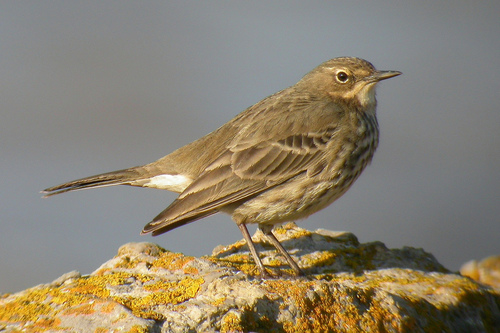
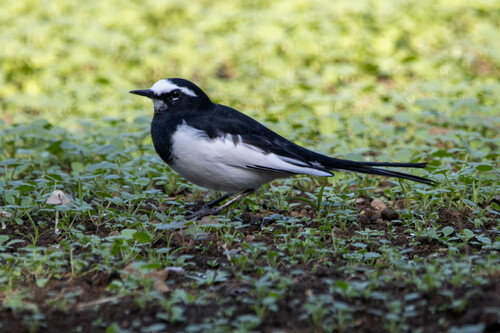
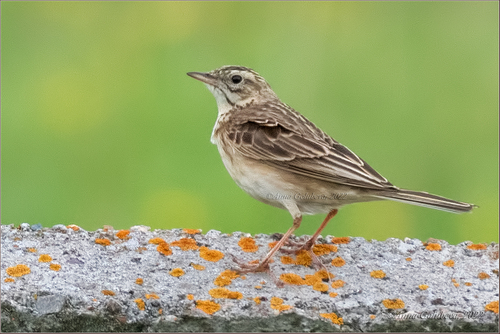
Anthus richardi Vieillot, 1818, commonly called Richard's pipit, is a large pipit species. Adults measure 17–20 cm in length, weigh 25–36 g, and have a wingspan of 29 to 33 cm. This is a slender bird that often holds an upright standing posture. It has long yellow-brown legs, a long tail with white outer feathers, a long dark bill with a yellowish base on the lower mandible, and a long, fairly straight hindclaw. When on the ground, it has an undistinguished appearance: it is mainly brown on its upper body and pale on its underbody. Dark streaks mark the upperparts and breast, while the belly and flanks are plain. Its face has strong contrasting markings, with pale lores and supercilium, and dark eyestripe, moustachial stripe and malar stripe. Two wingbars form from pale tips on the wing-coverts. Subspecies of this species show consistent physical variation: A. r. sinensis is slightly smaller than the nominate race, with less streaking on the upperparts; A. r. centralasiae is larger, with more sand-coloured upperparts; and A. r. dauricus has more streaking on the upperparts. Richard's pipit has a strong, undulating flight, and produces a characteristic explosive "shreep" call that is somewhat similar to the chirp of a house sparrow. Its song consists of a repeated series of monotonous buzzy notes, performed during an undulating song-flight. Care is needed to distinguish Richard's pipit from other large pipits that winter or are resident in the same areas, including Blyth's pipit and paddyfield pipit. Blyth's pipit differs from Richard's pipit in having a shorter bill, legs and tail, a shorter and more curved hindclaw, less white on the tail, and more streaking on the upperparts. In adult Blyth's pipit, the median wing-coverts have blunt-ended dark centres, while in Richard's pipit these dark centres taper to a point toward the tip of the feather. Blyth's pipit's call is also quieter and less harsh than Richard's pipit's call. Paddyfield pipit is smaller than Richard's pipit, with a shorter bill and tail, less streaking on the breast, and a quieter call. Richard's pipit breeds in southern Siberia, Mongolia, parts of Central Asia, and northern, central, and eastern China. It is a migratory species that travels south to winter in the Indian subcontinent and South-east Asia, with recorded occurrences as far south as Sri Lanka, Singapore, and northern Borneo. It is a scarce passage migrant in Korea and Japan. A small portion of the population regularly moves west in autumn, and individuals have been recorded in most countries across Europe, the Middle East, and North Africa. It is seen annually between September and November at coastal watchpoints in areas including Britain, the Netherlands, and Scandinavia, with occasional individuals appearing in spring. A small number of individuals overwinter in countries such as Spain, Portugal, Italy, and Morocco. This species occupies open country, particularly flat lowland areas. It inhabits grassland, steppe, and cultivated land, and prefers more fertile, moist habitats. In Europe, it is most often recorded on headlands and islands. It occurs either alone or in small groups. Like other pipits, Richard's pipit is insectivorous. It mainly forages for food on the ground, and will also make short flights to catch flying insects. It occasionally eats a small amount of seeds. Its nest is constructed from grass or moss, and is built on the ground beneath a grass tussock.