About Anthus pratensis (Linnaeus, 1758)
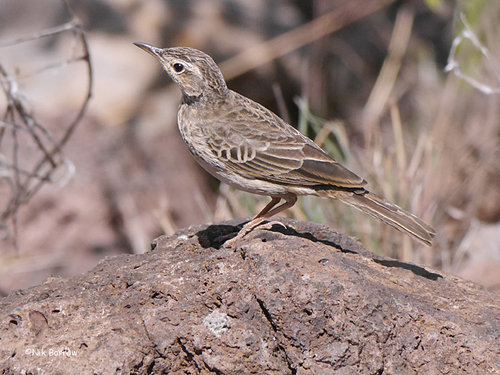
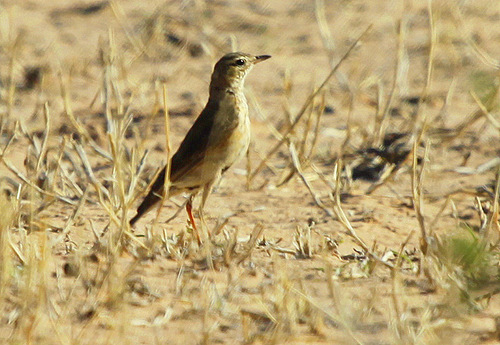
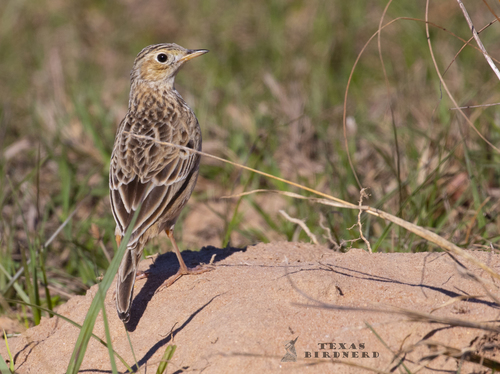
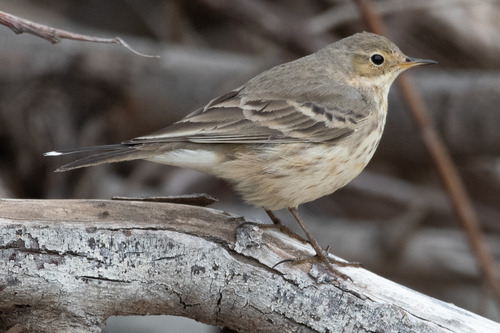
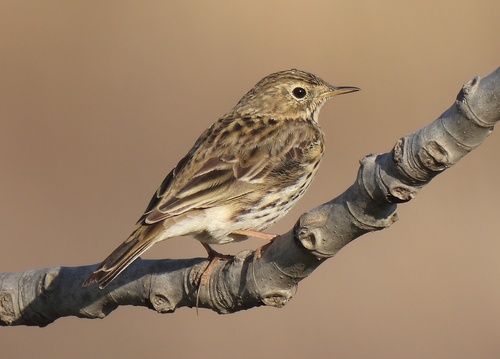
This is a widespread and often abundant small pipit, the meadow pipit Anthus pratensis. It measures 14.5–15 cm (5+1⁄2–6 in) in length and weighs 15–22 g (0.53–0.78 oz). When seen on the ground, it has a plain, easy-to-confuse appearance: it is mainly brown on its upperparts and buff on its underparts, with darker barring across most of its plumage. Its brown tail has narrow white edges along the sides. It has a thin bill, pale pinkish-yellow legs, and a conspicuously long rear claw that is longer than the rest of the rear toe. Its call is a faint tsi-tsi. Its simple, repetitive song is performed during a short song flight, and the song accelerates towards the end. Birds breeding in Ireland and western Scotland are slightly darker than individuals from other areas, and are often classified as the subspecies A. p. whistleri. This subspecies intergrades gradually with the nominate subspecies A. p. pratensis that occupies the rest of the species' range. The meadow pipit is similar in appearance to two related pipit species: the red-throated pipit A. cervinus, which has heavier barring and an orange-red throat only during summer, and the tree pipit A. trivialis, which is slightly larger, has less heavy streaking, stronger facial markings, and a shorter rear claw. The meadow pipit's song accelerates towards the end, while the tree pipit's song slows down. It primarily lives in open habitats, which can be uncultivated land or low-intensity agricultural land, such as grassland, moorland, and heathland. Small numbers also occur on arable land. During winter, it also uses saltmarshes and sometimes open woodland. It is a fairly terrestrial pipit that always feeds on the ground, but it uses elevated perches including shrubs, fence lines, or electric wires as vantage points to watch for predators. Its total population is estimated at 12 million pairs. It is an abundant species in the north of its range, and is generally the most common breeding bird of the British uplands, but it is less common further south. Breeding densities range from 80 pairs per square kilometre (210 pairs per square mile) in northern Scandinavia, to 5–20 pairs per square kilometre (13–52 pairs per square mile) in grassland in the south of the breeding range, and just 1 pair per square kilometre (2.6 pairs per square mile) in arable farmland. A few isolated breeding pairs have been recorded from south of the species' main range, in the mountains of Spain, Italy, and the northern Balkans. There has been a general population decline over the past 17 years, most notably in French farmland, where the species has declined by 68%. The meadow pipit's diet consists mainly of insects and other invertebrates, most of which are small items less than 5 mm (3⁄16 in) long. It also eats the seeds of grasses, sedges, rushes, and heather, along with crowberry berries, especially during winter.