About Anthus petrosus (Montagu, 1798)
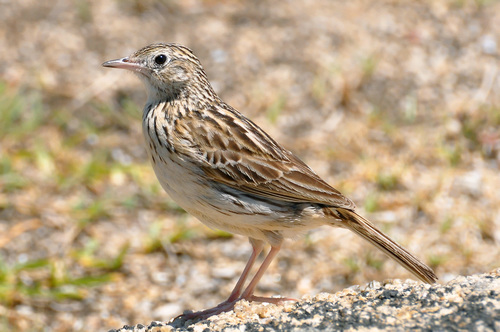
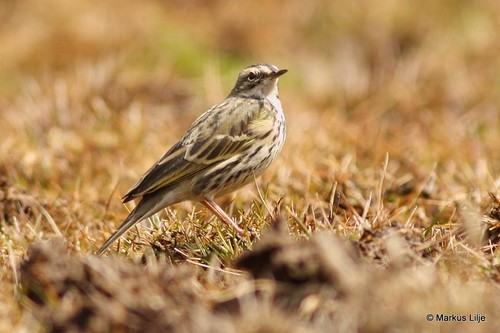
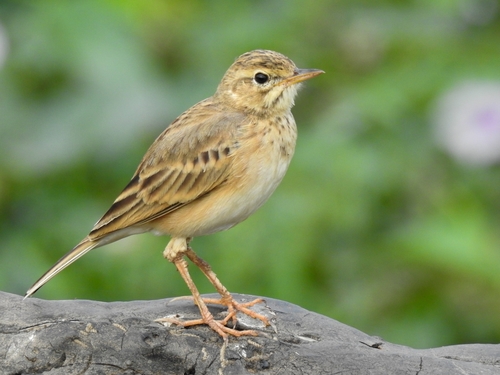
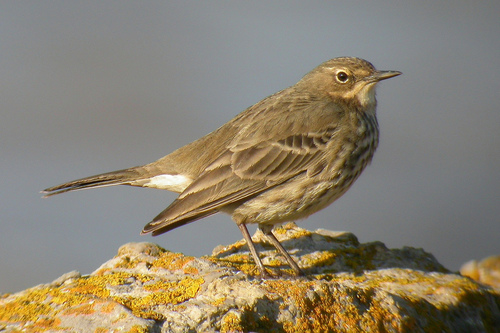
This species, with the scientific name Anthus petrosus (Montagu, 1798), is commonly called the European rock pipit. Adult European rock pipits measure 16.5–17 centimetres (6.5–6.7 in) in length and weigh 18–32.5 grams (0.63–1.15 oz). The nominate subspecies has smoky-olive weakly dark brown-streaked upperparts, and buff underparts that are heavily marked with poorly defined brown streaks. Its legs, bill, and iris are dark brown or blackish, and it has a pale eye-ring. Males and females look identical; although males average slightly brighter than females, there is full overlap between the sexes, and birds cannot be sexed by appearance or measurements. Immature birds resemble adults, though they may sometimes be browner and more heavily streaked on their upperparts, making them superficially similar to meadow pipits. The eastern subspecies A. p. littoralis can only be reliably told apart from the nominate subspecies when it has summer plumage. In summer, A. p. littoralis may show pinkish underparts and a pale supercilium (eyebrow), which makes it resemble the water pipit. European rock pipits can be easily distinguished from water pipits in winter, but it is very difficult to assign winter birds to a subspecies by appearance or measurements. Western populations of European rock pipits are nearly sedentary, so vagrant Eurasian rock pipits east of the Elbe basin are presumably mostly A. p. littoralis. Ringing results show that A. p. littoralis from Scandinavia winter widely within the breeding range of nominate A. p. petrosus in Britain, as well as further south in western Europe. These birds sometimes, but not always, are ecologically separated from the nominate subspecies, and tend to use more sheltered, muddier coasts with less stone cover than the nominate. Virtually all rock pipits found in southeastern England, where nominate A. p. petrosus does not breed, are A. p. littoralis. Adult European rock pipits undergo a complete moult between August and September. During this same period, juveniles replace their body feathers and some wing covert feathers, which gives them an appearance very close to that of adults. A partial moult occurs from late January to early March; the extent of this moult of some body and wing covert feathers, and sometimes the central tail feathers, varies between individual birds. The European rock pipit is closely related to the water pipit and the meadow pipit, and looks quite similar to both species. Compared to the meadow pipit, the European rock pipit is darker, larger, and longer-winged, and has dark legs instead of the meadow pipit’s pinkish-red legs. Winter-plumage water pipits can easily be confused with European rock pipits, but water pipits have a prominent supercilium, greyer upperparts, and are typically much warier than European rock pipits. The European rock pipit also differs from all its close relatives by having dusky rather than white outer tail feathers. The breeding season habitats used by European rock pipits and water pipits are completely separate, and there is very little overlap between their habitats even when the birds are not nesting. The song of the European rock pipit is a sequence of around twenty tinkling cheepa notes, followed by a rising series of thin gee calls, and ends with a short trill. Its flight call is a shrill pseep, which is intermediate between the soft sip sip sip call of the meadow pipit and the short, thin fist call of the water pipit. The European rock pipit is almost entirely a coastal species, and most often occurs in rocky areas typically below 100 metres (330 ft) in elevation. However, on St Kilda it breeds at elevations up to 400 metres (1,300 ft). This species is not bothered by wind or rain, though it avoids extremely exposed locations. It may travel further inland during winter or while migrating. Its breeding range covers temperate and Arctic Europe along western and Baltic Sea coasts, and a very small number of individuals sometimes nest in Iceland. The nominate subspecies is largely resident, with only limited movement. A. p. littoralis is mostly migratory, and winters on coasts from southern Scandinavia to southwest Europe, with a few individuals reaching as far south as Morocco. Wandering individuals have been recorded as far as Spitsbergen and the Canary Islands, but records of this species away from the coast in Europe are rare. One example is a male shot at Dresden in 1894, now held in the collection of the local State Museum of Zoology, which is the only known specimen from Saxony. Migratory populations leave their breeding grounds in September and October, and begin returning to their breeding ranges from March onwards; in the far north, they may not arrive before May.