About Anthus nilghiriensis Sharpe, 1885
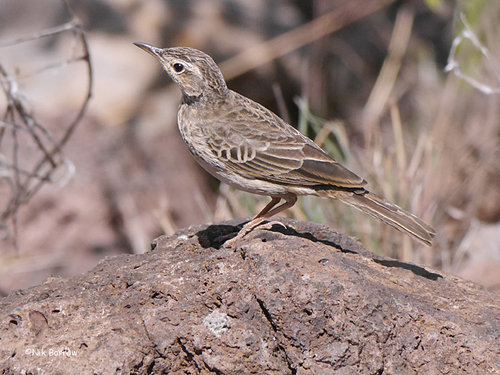
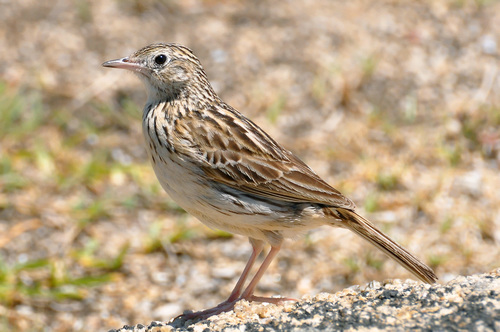
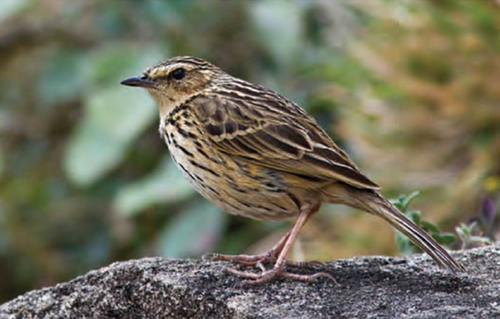
The Nilgiri pipit, scientifically named Anthus nilghiriensis Sharpe, 1885, measures approximately 12.6 to 14 centimetres (5.0 to 5.5 inches) in length. It has richly colored plumage, dark lores, a buff supercilium and throat, and no malar stripes. Its flanks, breast, and sides of the neck are a brighter buff shade, and its entire bill is dark. Both the crown and upperparts have heavy black streaking. The outer tail feathers are buff colored, and no white appears in any of its plumage. Fine streaking covers the breast, and this streaking continues along the flanks. The first four wing primaries are nearly equal in length, while the fifth is about 1 to 2 mm shorter. Primaries two through five are emarginate. The tail feathers are pointed; the second outer tail feather has a tapering triangle along its shaft, and the third has a small triangle at its tip. Rare abnormal albino individuals of this species have been reported. In terms of distribution and habitat, the Nilgiri pipit is closely tied to short montane grasslands that are mixed with marshy areas and small streams. It is mostly found on hill slopes above 1,000 metres (3,300 ft) in the Ponmudi hills, and above 1,500 metres (4,900 ft) in the Nilgiris, Palani, and High Ranges. There have been claims that the species occurs in the Kalakkad Mundanthurai Tiger Reserve, but a 2014 study indicates the species is only found on the high altitude grassy peaks of the Nilgiris and the Anamalais. Museum specimens of the Nilgiri pipit exist from the Palani ranges, but habitat changes may have caused population reduction or complete extirpation, as the species has not been located in 21st century surveys there.