About Anthus hodgsoni Richmond, 1907
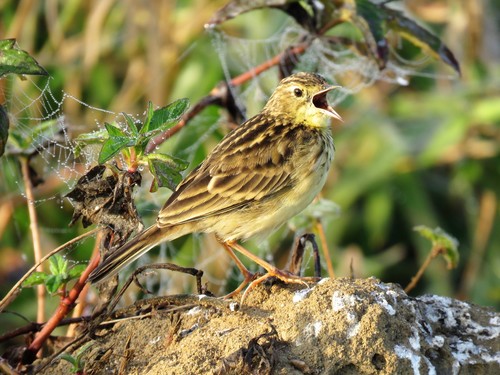
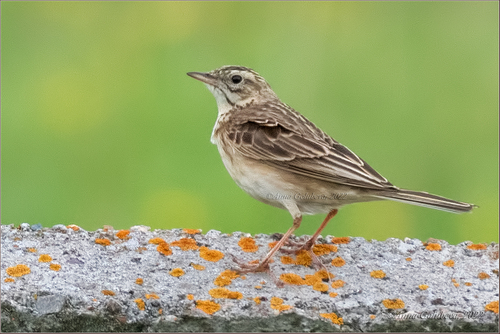
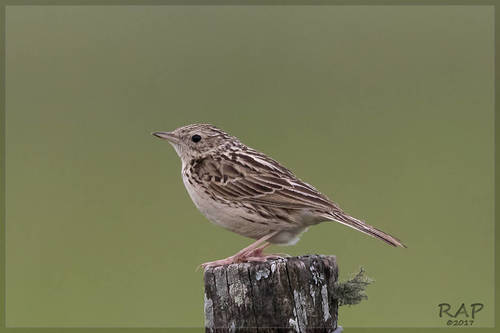
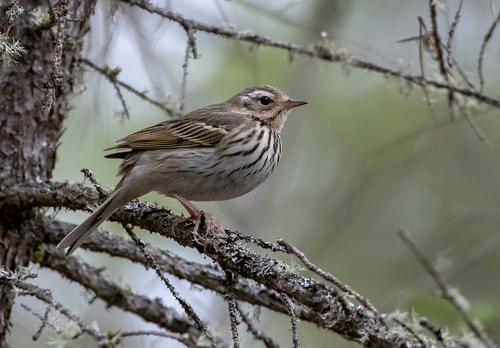
The olive-backed pipit, formally named Anthus hodgsoni Richmond, 1907, measures approximately 15 cm (5.9 in), which is slightly larger than a sparrow. Its upperparts are greenish brown streaked with darker brown; the supercilium, double wingbar, and outer rectrices are whitish. Its underparts range from whitish to buff, with dark brown streaks on the breast and flanks. Males and females have identical plumage. This species is typically seen alone or in pairs. It forages by moving across the ground, and flies up into trees when disturbed. Its flight is jerky and undulating. Its song, given while in flight, is lark-like. The song is similar to that of the tree pipit, but is faster and higher pitched. Its call is a single tseep or spek, which is also similar to the tree pipit's call. Its diet consists largely of insects, but it also consumes grass and weed seeds. During the breeding season, its distribution ranges from Himalayan Pakistan and India westward through Nepal into China, reaching as far north as Gansu province. From there it extends east through Korea to Japan, and north through north central Asia into northeastern Europe, specifically European Russia. It is an occasional rare vagrant to western Europe. In eastern Nepal, it breeds at elevations up to 4,500 m (14,800 ft). In winter, it occupies a broad southern area across Asia, stretching from peninsular India east to Southeast Asia and the Philippines. It favors open country generally; it spends the winter in evergreen woodland, and breeds in groves and wooded habitats.