About Anthropoides virgo (Linnaeus, 1758)
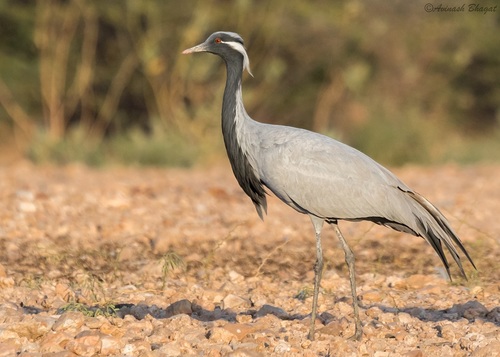
The demoiselle crane, known scientifically as Anthropoides virgo (Linnaeus, 1758), is the smallest species of crane. It ranges from 85–100 cm (33.5–39.5 in) in length, 76 cm (30 in) in height, and has a wingspan of 155–180 cm (61–71 in), with a weight between 2–3 kg (4.4–6.6 lb). It is slightly smaller than the common crane, but has similar plumage. It has a long white neck stripe, black foreneck color that extends down over the chest in a plume, and a loud, higher-pitched trumpeting call than the common crane. Like all other cranes, it performs a dancing display, which is more balletic and involves less leaping than the display of the common crane.
Demoiselle cranes breed across central Eurasia, stretching from the Black Sea east to Mongolia and northeast China. Their breeding habitats are open areas with sparse vegetation, typically located near water. During winter, they migrate to one of two regions: either the Sahel region of Africa, from Lake Chad east to southern Ethiopia, or the western regions of the Indian subcontinent. Two former populations are now extinct: a small population that previously existed in Turkey, and an isolated resident population in the Atlas Mountains of northwest Africa. On the Indian subcontinent, where demoiselle cranes spend the winter, they form large flocks that gather on agricultural land, and roost overnight in shallow open water.