About Anthriscus sylvestris (L.) Hoffm.
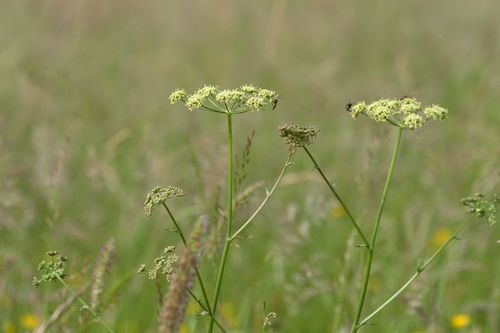
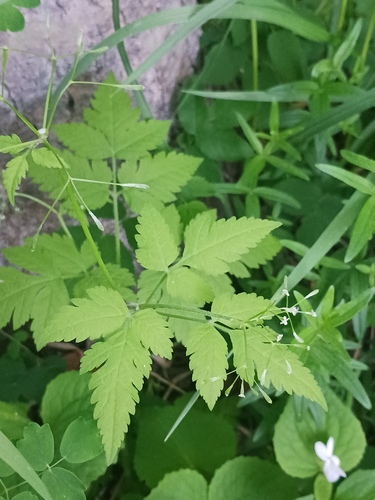
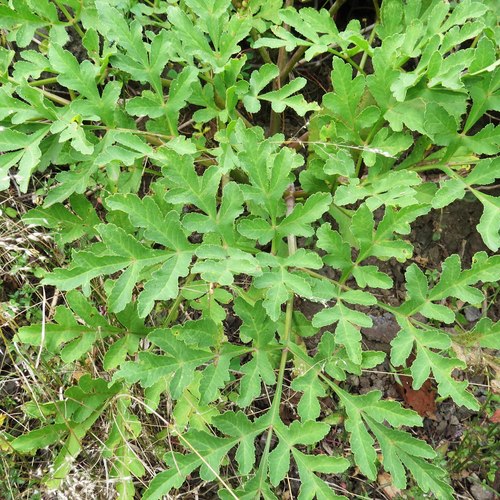
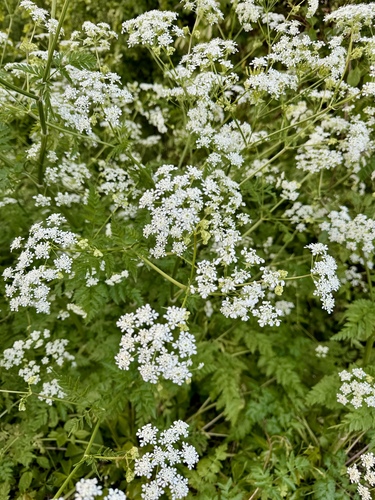
Anthriscus sylvestris, commonly known as cow parsley, is an upright non-woody herbaceous perennial that grows 60–170 centimetres (24–67 inches) tall. Its stems are hollow, striate (marked with parallel longitudinal stripes), furrowed, and green with patches of purple, reaching up to 1.5 cm (0.59 in) in diameter. Tiny, hard-to-see hairs cover the stems, leaf rachis, and leaf stalks, though these hairs are easily detectable by touch. Leaf petioles clasp the stem at their base; they are broad and flattened, with a downy margin, and the rachis features a deep grooved channel. The leaves are triangular, 2–3 pinnate, roughly 30 cm wide and 45 cm long, green, and have a fern-like or feathery appearance, with hairs on the underside. The lowest primary division of the leaf is much smaller than the other divisions. Flowers are arranged in compound umbels on short pedicels (less than 1 cm), with a ring of short, stout hairs at the apex. Downy oval bractioles with red pointed tips grow on the umblets, which are arranged on 4–10 rays 1.5–3 cm long. The rays are glabrous (smooth and hairless), and no bract is present. Peduncles are similar in length to the rays, more or less glabrous and furrowed. Each individual flower has 5 white petals, 2 stamens, and 2 styles with an enlarged base that forms a swelling called a stylopodium at the apex of the ovary. The main stem connects to a single primary taproot that can branch further below the soil surface, and lateral rhizomes can grow from the roots. In the United Kingdom, cow parsley flowers from April to early June. Cow parsley grows in sunny to semi-shaded locations in meadows, and at the edges of hedgerows and woodland. It is an especially common plant along roadsides; its frothy early-flowering white blooms mean it is considered the most important springtime landscape wildflower in Britain. However, the species is also common enough and fast-growing enough to be considered a nuisance weed in gardens. Its ability to spread rapidly via rhizomes and produce large quantities of seeds in a single growing season has made it an invasive species in many areas of the United States. Vermont has added cow parsley to its Watch List of invasive species, while Massachusetts has banned the sale of the plant. It has been classed as a Class B Noxious Weed in the State of Washington since 1989, where its sale is also banned. In Iceland, cow parsley is classified as an alien invasive species. All above-ground parts of cow parsley are edible, with a flavour sharper than garden chervil, described as grassy parsley with a faint hint of licorice or aniseed. However, some sources suspect it is mildly toxic. Because it is an invasive species in many areas outside its native range and spreads easily along roads and the edges of woods and fields, it is not cultivated and is instead foraged in the wild. In the UK, it is foraged from February to November. Extreme caution is advised when foraging cow parsley, because it is easily confused with other poisonous Apiaceae family species: deadly poison hemlock, hemlock water-dropwort, and fool's parsley. Because its flavour is considered unremarkable and the risk of misidentification is great, foraging for wild cow parsley is usually strongly discouraged.