About Anthriscus cerefolium (L.) Hoffm.
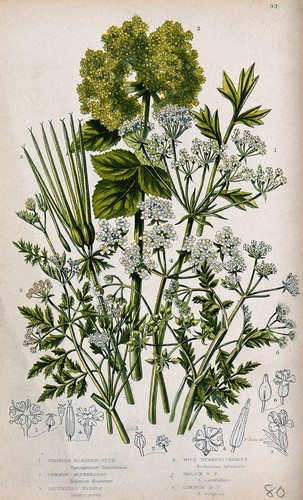
Anthriscus cerefolium (L.) Hoffm., commonly known as chervil, is a member of the Apiaceae family. Plants of this species grow between 40 and 70 cm (16 to 28 in) tall, and produce tripinnate leaves that may be curly. Their small white flowers are arranged into small umbels that measure 2.5 to 5 cm (1 to 2 in) across. The fruit is roughly 1 cm long, shaped oblong-ovoid, and bears a slender, ridged beak. Chervil’s native distribution is uncertain because it has been cultivated for a very long time, particularly by the Romans. The New Oxford Book of Food Plants restricts its native range to the Caucasus, while Plants of the World Online records a broader native range spanning central and southeastern Europe, and southwestern Asia, stretching from Switzerland in the west to Iran in the east. Today, the species is naturalized across most of Europe and North Africa. It is also introduced, frequently grown, and naturalized in many areas of North America. Escaped naturalized chervil in North America can be distinguished from two other native Anthriscus species in the region—A. caucalis and A. sylvestris—by its lanceolate-linear bracteoles and fruit with a relatively long beak. Transplanting chervil is difficult because of its long taproot. It grows best in cool, moist locations; without these conditions, it bolts (rapidly goes to seed) quickly. It is typically cultivated as a cool-season crop similar to lettuce, planted in early spring, late fall, or grown in a winter greenhouse. Regularly harvesting chervil leaves also reduces the chance of bolting. If plants still bolt despite precautions, new seeds can be re-sown periodically throughout the growing season to produce fresh plants as older bolted plants stop producing usable growth.