About Anthrenus scrophulariae (Linnaeus, 1758)
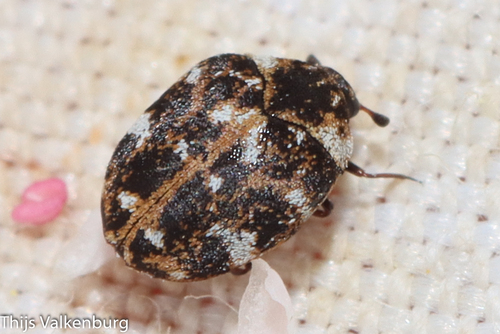
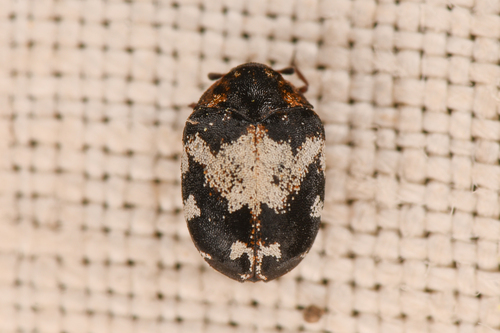
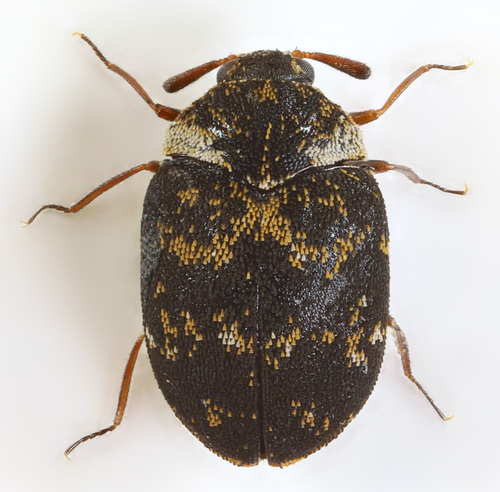
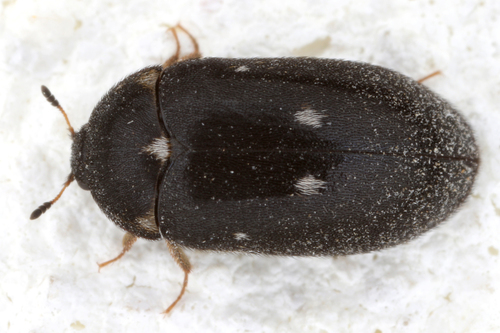
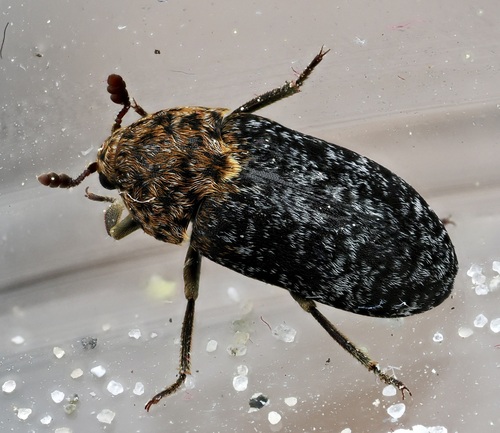
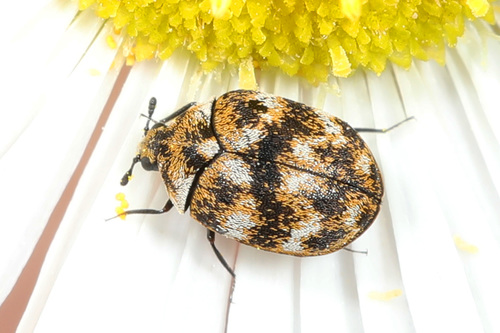
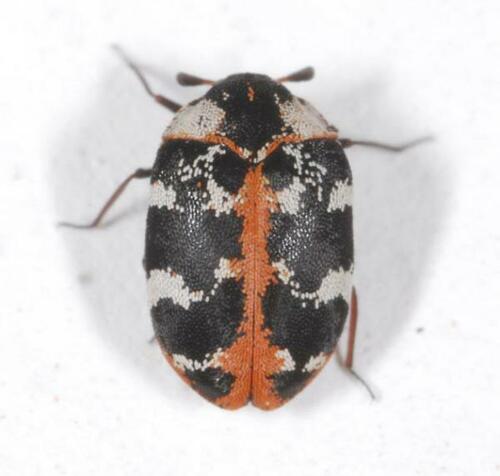
Description: The adult common carpet beetle (Anthrenus scrophulariae) ranges in length from approximately 2.5 to 3.8 mm (0.10 to 0.15 inches). Its antennae have eleven total segments, with three segments forming a terminal club, and its eyes have a notch on the front edge. The head is black, but is mostly hidden under the prothorax, which is also black. The prothorax is freely speckled with white scales, except for a central band that lacks this speckling. The elytra, or wing cases, are black, with orange or reddish scales near the midline, and variable but symmetric patches of white scales across the rest of the surface. As individual beetles age, their scales tend to rub away, which changes the beetle’s outward appearance. The small, white eggs are laid in batches of 30 to 60, and have small projections that help them stick to carpet fibers. The larvae are brown, and moult five times before entering the pupal stage. The final larval instar is hairy, and is larger than the fully developed adult beetle. Pupation occurs inside the shed skin of the last larval instar. Distribution: The common carpet beetle originated in the Palaearctic region, but has been widely introduced to other areas, and is now found across most of the world. It is more common in temperate regions of the northern hemisphere, and less common in the tropics and humid regions. Life cycle: Adult common carpet beetles feed on pollen and nectar, and typically prefer white or whitish flowers including buckwheat, wild aster, daisy, Spiraea, and Ceanothus. This diet supports mating and egg-laying. Females search for appropriate locations containing animal hairs or fibers to lay their eggs; these locations include bird and animal nests, beehives, and the skins of dead animals, as well as indoor spaces like carpets, upholstery, fabrics, and preserved animal material. Eggs hatch between two and three weeks after being laid, and the larvae chew through whatever animal fibers are available in their habitat. After approximately two months, the larvae pupate. Adult beetles emerge around one month later, and if they developed indoors, they travel out into open air.