About Anthrenocerus australis (Hope, 1843)
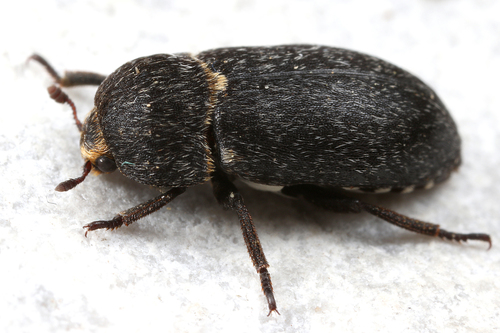
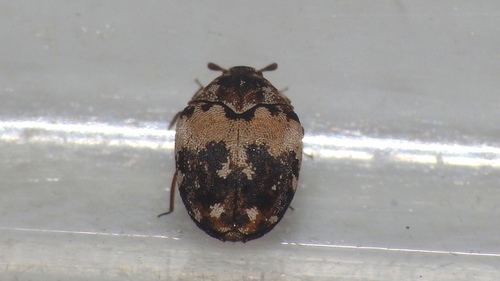
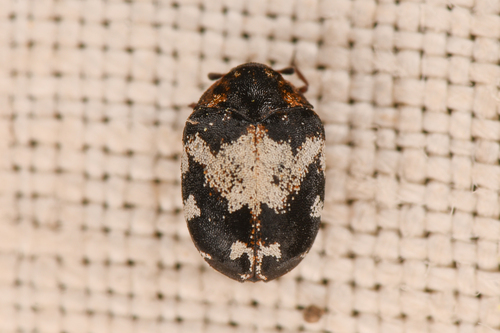
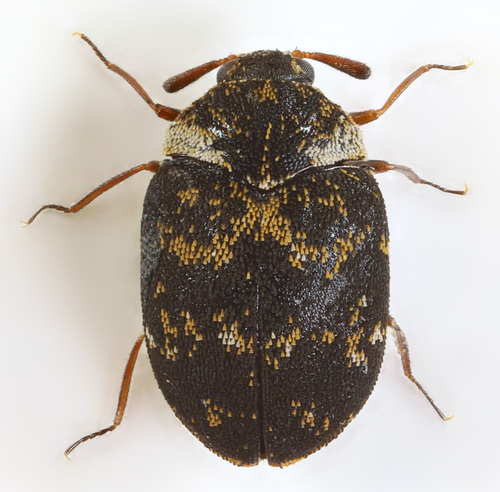
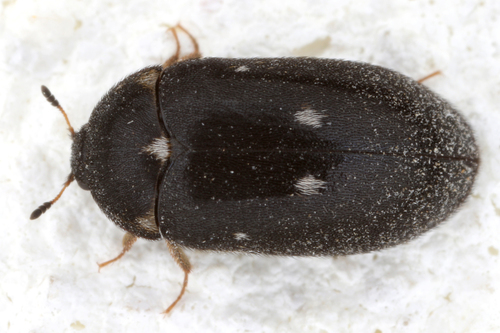
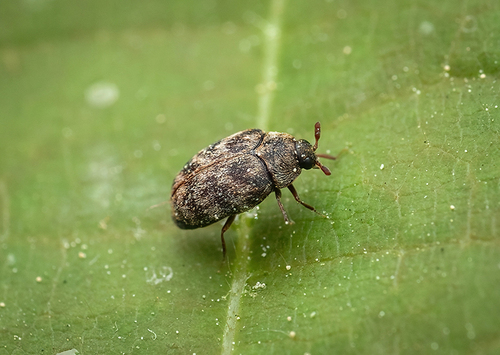
Adults of Anthrenocerus australis are dark brown and black oval-shaped beetles that reach 2.2–2.5 mm in length. Two small eyes and a pair of antennae sit at the front of the head; six outward-facing legs and a mouth are positioned below. The rear of the body has a hardened protective shell that covers the delicate wings when they are retracted and the beetle is not flying. When disturbed or threatened, adult A. australis freeze and fold their legs against their body. A. australis larvae are hairy and elongated, with a caterpillar-like eruciform shape, described also as grub-like. They can grow up to 7 mm long, with a head, mouthparts, six legs at the front of the body, and an extended abdomen. Larvae are covered in spicisetae: long protective hairs that defend the developing insect from predators. When a threat is detected, these hairs stand erect like sharp needles and can lodge into the predator’s body. A distinct feature of A. australis larvae is their complete setal bands marked with colourful, distinctive white and tan patterns. Anthrenocerus australis was first described in 1843 by English entomologist Frederick William Hope, who discovered, collected, and named many beetle species. Adult A. australis do not require food to produce viable eggs, a trait that may help the species spread widely, as they can reproduce on any surface even without access to food or water. Gerrard observed that studied beetles will seek out nectar sources if possible, often after laying their first batch of eggs, which encourages species dispersal. Transport of the beetle through imported and exported goods has led to established populations across the world, including in the United Kingdom, the Netherlands, Germany, France, and Belgium. A. australis survives British winters and has persisted in Britain for over a century, but summer temperatures there are often not warm enough to support healthy breeding rates, so the species is not considered a pest in Britain. While it is not classified as an important pest in most of the countries it has invaded, it holds high pest status in New Zealand. After mating, female A. australis fly to sheltered locations where newly hatched larvae will have access to food to lay their eggs. Females can lay up to forty tiny oval, cream-coloured eggs, each less than one millimetre long. They deposit each egg individually in crevices within fibrous or animal-based materials, such as wool, cotton, or the hair and skin of dead animals. Laying eggs separately maximizes the offspring’s chance of survival, and eggs generally take 10 to 20 days to hatch. Females choose insulated, well-protected materials to lay eggs so hatching larvae have an immediate food source. Larvae hatch in spring and early summer. Once they emerge, larvae burrow into the material where their eggs were laid and begin feeding. They are scavengers that prefer natural fibres including silk, leather, feathers, wool, and hair, as well as plant fibres like cotton and other foodstuffs. They also feed on the skin and hair of dead animals and insects, and on spider webs. Throughout the larval stage, immature beetles moult (perform ecdysis) several times as they progress through new developmental stages. Larvae can live between one and three years, and hibernate during cold periods until warmer weather returns. In a protected artificial environment like a glass jar, researcher Wakley observed that larvae continued to thrive for over twenty years. When conditions are warm and dark, within the food source they have colonized, larvae complete their final moult and become pupae. After 10 to 30 days in the pupal stage, they emerge as fully mature adult A. australis beetles. Unlike larvae, adult beetles are attracted to light, and are commonly found foraging outside, where they feed on pollen and nectar from flowers. Fully grown adults live in nests and dead animal remains. They may also be found in bee, wasp, and ant nests, though the inhabitants of these nests are natural predators that will eat A. australis. Common predators of A. australis include birds, mammals, lizards, frogs, ants, spiders, and parasitoid wasp larvae. Fully mature adult A. australis only live for two to six weeks.