About Anthrax analis Say, 1823
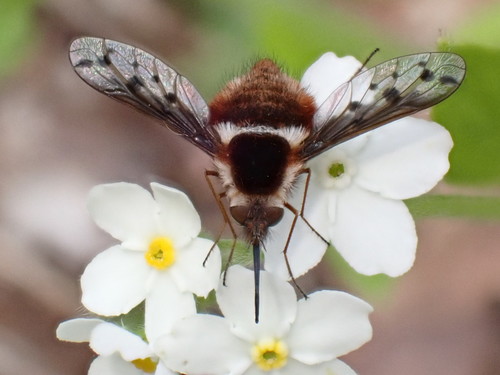
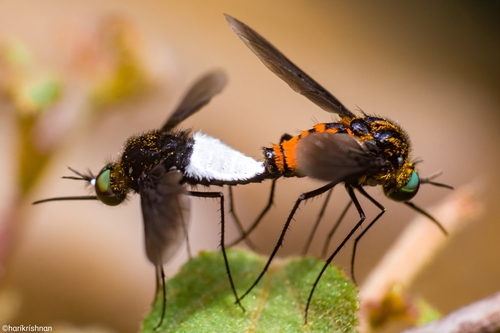
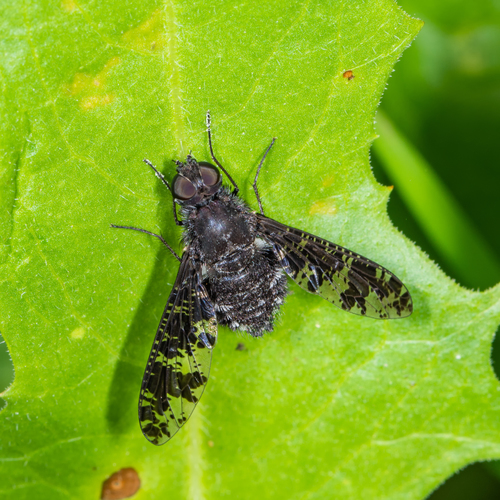
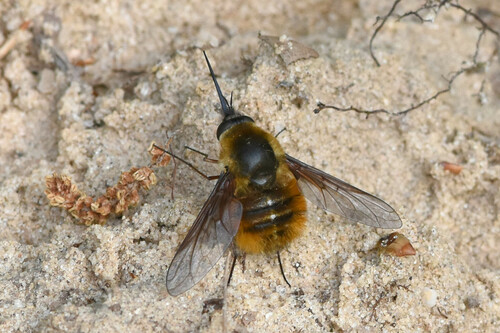
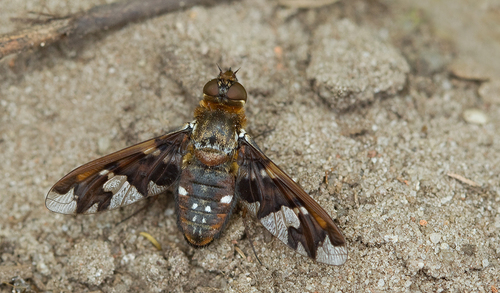
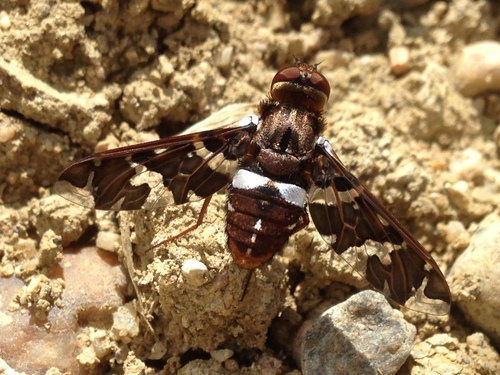
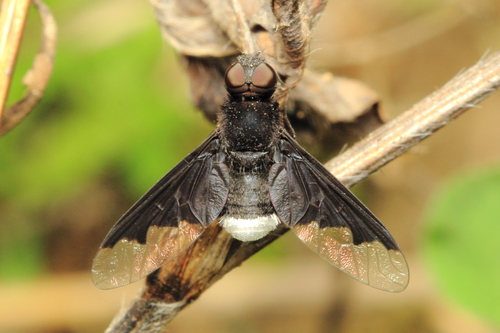
Anthrax analis, commonly known as the black bee fly, is a species of bee fly in the family Bombyliidae. This species is distributed across North America, ranging from Yukon east to Quebec in Canada, across the entire mainland United States, through most of Mexico, and extending south as far as Costa Rica and Cuba. Adult black bee flies act as pollinators, while larvae are parasitoids of tiger beetles in the genus Cicindela, and are likely also parasitoids of solitary bees. The species has variable appearance: the posterior half of the wings is usually transparent, but populations in the eastern United States may have entirely dark wings. The body is covered in black hair, and the tip of the abdomen usually bears silvery scales. The life cycle of Anthrax analis starts with the egg stage. After fertilization, adult females lay eggs on soil near the nests of tiger beetles, which their future larvae will parasitize. The eggs are tiny and oval-shaped, and are often camouflaged to match their surroundings. This placement of eggs guarantees that newly hatched larvae have immediate access to their hosts. Once they hatch, A. analis larvae look like small worms, with soft bodies and no wings. They start their parasitic life by invading nearby host nests, and feed on host beetle larvae. As they grow, they move through the nest, continuing to feed and molting several times. The main goal of this larval stage is to accumulate enough nutrients to support development into the pupal stage. After completing the larval stage, the black bee fly enters pupation, which usually takes place inside host burrows or in nearby soil. During pupation, the pupa does not show external activity, but it undergoes major internal developmental changes. The pupal case is typically hidden for protection, either buried underground or camouflaged. When the adult emerges from the pupa, it has fully developed, hardened body structures, wings, and functional reproductive organs. Adult female A. analis are often observed hovering near the entrances of tiger beetle nests, and will occasionally lay eggs close to the beetle larvae.