About Anthracothorax veraguensis Reichenbach, 1855
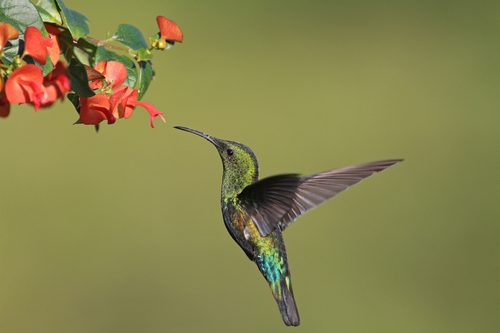
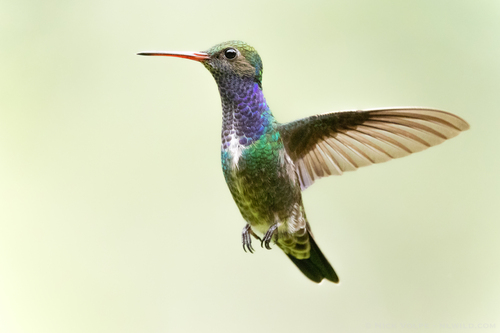
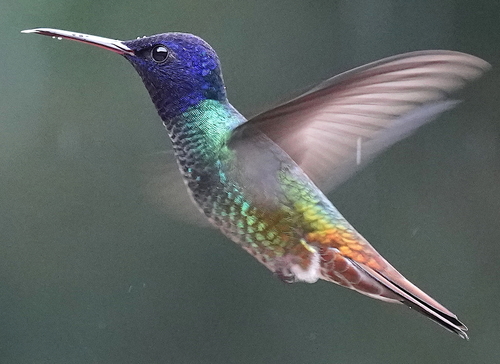
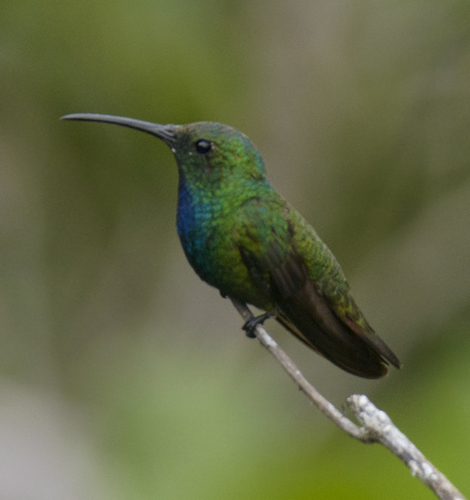
The Veraguan mango (Anthracothorax veraguensis Reichenbach, 1855) is a medium-sized hummingbird species that grows 11–12 cm long. Both sexes have metallic green plumage, a slightly decurved dark grey beak, and black tail feathers that each have a central red circle. This species shows sexual dimorphism: males have blueish breasts and bellies, while females have white-cream bellies with a dark teal stripe running down the breast. The morphology of the Veraguan mango is very similar to the Green-breasted mango, but the Veraguan mango lacks black plumage on the throat. Unlike the black ventral stripe found in the Green-breasted mango, the stripe is teal colored in female Veraguan mangos. The species is named after Veraguas Province, Panama, the region where it was first discovered. It is common across most of Panama's Pacific coastline, and ranges north into Costa Rica. Until recently, it was thought to be endemic to Panama, but it has now been sighted in the southern Pacific lowlands of Costa Rica, and was added to the official list of birds of Costa Rica in 2009. Like other hummingbirds, the Veraguan mango feeds on nectar and invertebrates. It has been observed feeding on the flowers of Erythrina gibbosa in Costa Rica, and on flowers of other Erythrina species at other locations.