About Anthracothorax prevostii (R.Lesson, 1832)
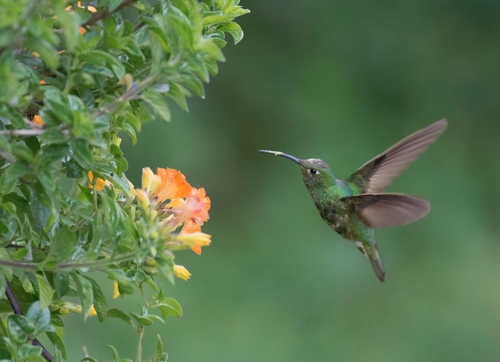
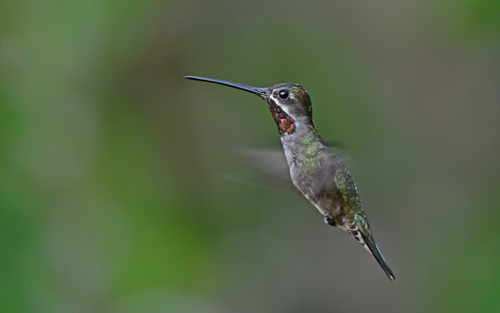
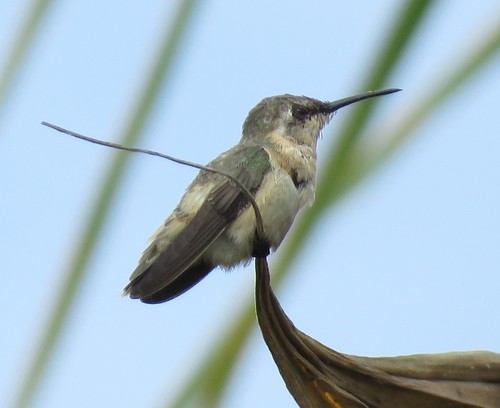
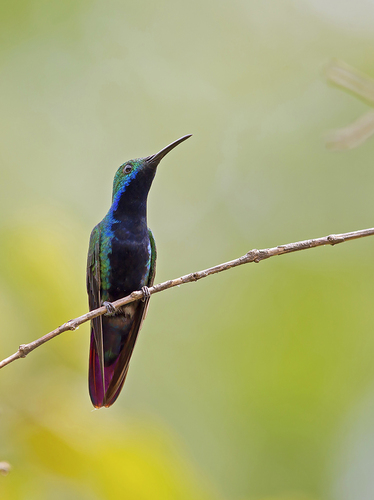
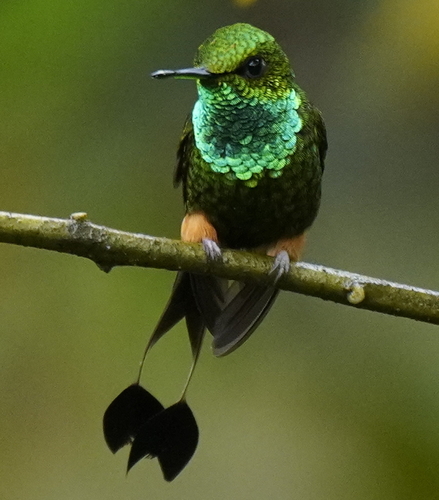
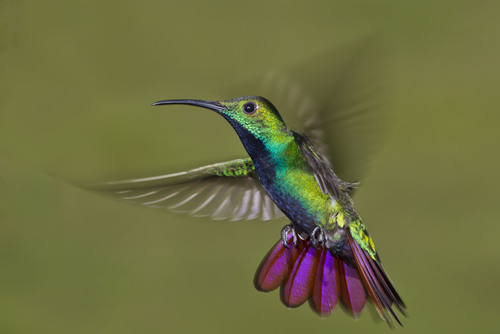
Anthracothorax prevostii, commonly called the green-breasted mango, measures 10.3 to 12.1 cm (4.1 to 4.8 in) in length and weighs 5.7 to 7.0 g (0.20 to 0.25 oz). All subspecies of both sexes have a slightly decurved dull black bill. Adult males of the nominate subspecies A. p. prevostii have metallic bronze green crowns, napes, and upperparts. Their innermost pair of tail feathers are dull dusky bronze green to dull coppery bronze, while the outer four pairs are shades of purple with a metallic gloss. Their wings are dusky brownish slate. They have a velvety black stripe running down their chin, throat, and chest, with metallic bluish green along the sides of this stripe. Their sides and flanks are bronze green, and their undertail coverts are dusky purple. Nominate females have less bronzy metallic green on their crowns, napes, and upperparts than males. Their innermost pair of tail feathers match the male’s dull dusky bronze green to dull coppery bronze coloring, but their outer four pairs are blue-black with a wide purple base and whitish tips. They share the male’s velvety black chin and throat stripe, but this stripe becomes bluish green on the breast and dusky on the belly, and is edged with white. The rest of their underparts are metallic green, except for dusky undertail coverts that have wide white edges. Juveniles are similar to adult females, but have a white chin, throat, and center of the breast with some chestnut coloring beside this white area. Subspecies A. p. gracilirostris has a shorter and thinner bill than the nominate subspecies. Its upperparts and sides are less bronzy, its underside stripe is wider and bluish black, and its undertail coverts are darker than the nominate’s. A. p. hendersoni also has a shorter bill than the nominate. It has an ashy tinge on its crown and a longer, thinner bluish black stripe. A. p. viridicordatus has bright grass green upperparts, olive green central tail feathers, and darker undertail coverts than the nominate. The four subspecies of green-breasted mango have the following distributions. A. p. prevostii is found from San Luis Potosí and southern Tamaulipas in Mexico south to Guatemala, Belize, and El Salvador. A. p. gracilirostris ranges from El Salvador south through Honduras, Nicaragua, and Costa Rica into Bocas del Toro Province in northwestern Panama. A. p. hendersoni is found on Providencia and San Andrés islands, which lie off the coast of Nicaragua but are part of Colombia. A. p. viridicordatus occurs in extreme northeastern Colombia and coastal Venezuela from the Guajira Peninsula to Sucre state. Many individuals of the nominate subspecies have wandered to the United States. Since 1988, there have been at least 25 records of the species in Texas. Single stray birds have been recorded in Cabarrus County, North Carolina in 2000; Rock County, Wisconsin in 2007; Laurens County, Georgia from 2007 into 2008; and Caddo Parish, Louisiana in 2009. The green-breasted mango lives in a variety of lowland tropical landscapes, most of which are semi-open to open. These habitats include shrublands with trees, savanna, secondary forest, gallery forest, mangroves, and the edges of denser forest. It also occurs in cultivated areas, parks, gardens, and suburban and urban areas. In terms of elevation, it mainly occurs from sea level to 500 m (1,600 ft), but can be found locally as high as 1,100 m (3,600 ft) in Central America.