About Anthracothorax nigricollis (Vieillot, 1817)
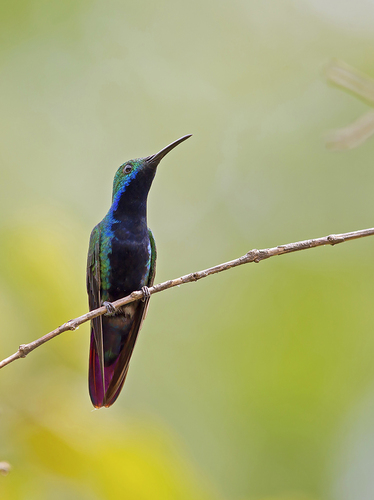
The black-throated mango (Anthracothorax nigricollis) has a total length of 10.2 to 14 cm (4.0 to 5.5 in) and weighs 6 to 9 g (0.21 to 0.32 oz). Both sexes of both recognized subspecies have a slightly decurved black bill. Adult males of the nominate subspecies have a metallic bronze-green crown, nape, and upperparts. Their innermost pair of tail feathers are dusky bronze green, while the outer four pairs are metallic magenta-rufous with dark blue edges and a violet sheen. Their wings are grayish brown. They have black coloration on the chin, throat, and center of the chest, with metallic bluish green extending to the sides of this area and to the vent. Their sides and flanks are bronzy green. Nominate subspecies adult females have metallic green on the crown, nape, and upperparts, which lacks the bronzy tone seen in males. Like males, their innermost pair of tail feathers are dusky bronze green, but the outer four pairs are rufous with a wide purple base and whitish tips. They have a thin, ragged black stripe along the chin and throat, bordered by white. The rest of their underparts are green. Juvenile black-throated mangoes are somewhat similar to adult females, but have a white chin, throat, and breast marked with a thin central black line. Some brown coloration on the head and back feathers creates a barred appearance. The tips of their lower back and rump feathers are dull cinnamon-buff. Juvenile females have rusty or buff coloration beside the white underparts, green undertail coverts, and a mostly dull carmine underside to the tail. Within the nominate subspecies, the green shade of the upperparts varies from pure dark green to green with a copper or bronze tone. Subspecies A. n. iridescens is essentially identical to the nominate subspecies. The nominate subspecies of black-throated mango is distributed from western Panama into most of Colombia and Venezuela, the Guianas, eastern Ecuador and Peru, northern and eastern Bolivia, eastern Paraguay, far northern Argentina, most of Brazil, and the islands of both Trinidad and Tobago. It has also been recorded as a vagrant in Uruguay. Subspecies A. n. iridescens occurs in extreme southwestern Colombia, western Ecuador, and extreme northwestern Peru. The black-throated mango lives in a range of lowland tropical landscapes, most of which are semi-open to open. These habitats include gallery forests, shade coffee and cacao plantations, the edges of dense forest, and parks and gardens in settled areas. While it is generally a lowland species, it can be found up to 1,400 m (4,600 ft) in Venezuela, 1,700 m (5,600 ft) in Colombia, and 2,000 m (6,600 ft) in eastern Brazil.