About Anthracophyllum archeri (Berk.) Pegler
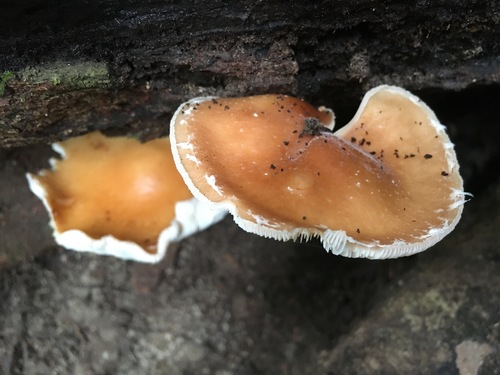
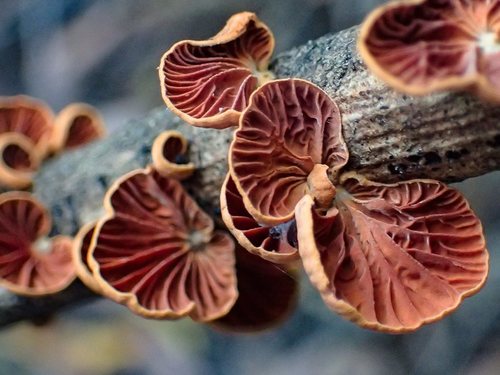
The fruit bodies of Anthracophyllum archeri are rust-colored to dark red and fan-shaped, and grow in groups on dead twigs. Caps average 3–20 mm (0.1–0.8 in) in diameter. These horizontal caps attach laterally to their substrate, are sessile, and have a very small thickened stem-like point. Their shape ranges from reniform to almost circular, convex, and almost symmetrical, with deep grooves that radiate from the point of attachment and follow the outline of the gills. The pileus (cap) is colored creamy pale pink to reddish brown, has a smooth texture, and is covered in scaly whitish dust when young. Gills are orange to brown, widely spaced, and radiate from the pale thickened attachment point that connects the fungus to its substrate. Spores are translucent, measure 7.5–12.5 μm long by 5–8 μm wide, and produce a white spore print. The context (fungal tissue) is 1–2 mm (0.04–0.08 in) thick, pale, and has a thickened wall. This fungus is found in native forests throughout New Zealand, in Australia along the East Coast, in Tasmania, and in the South West region of Western Australia. It has also been observed on Lord Howe Island, Raoul Island, and Te One. Anthracophyllum archeri grows on dead wood including fallen twigs, branches, and stumps, mostly from angiosperm species. It is common in rainforests of both Australia and New Zealand, as well as in wet and dry sclerophyll forests. It is a saprotrophic fungus, meaning it obtains energy by breaking down dead organic material. Anthracophyllum archeri contains diacetylatromentin, a multi-use pharmaceutical compound that can be isolated from its fruiting bodies. It also contains a yellow pigment called anthracophyllin.