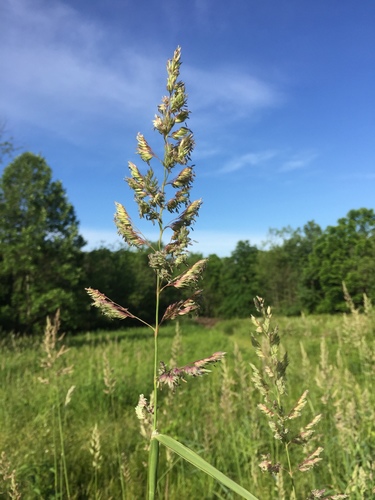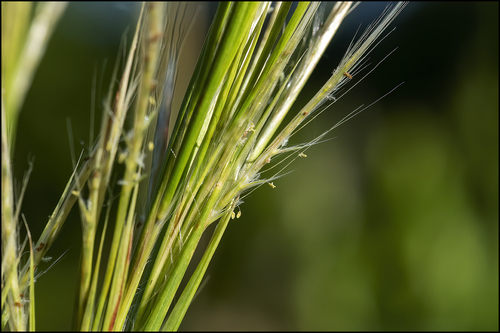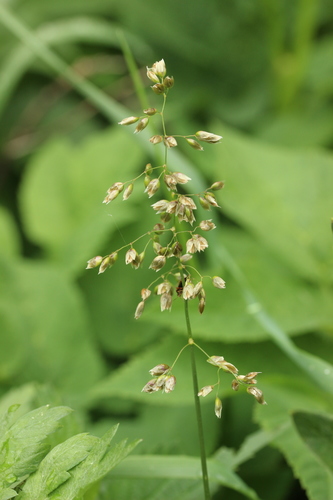
About Anthoxanthum nitens (Weber) Y.Schouten & Veldkamp
This species is previously known as Hierochloe odorata, commonly called sweetgrass. It is an extremely hardy perennial that can grow within the Arctic Circle. Its leaves do not form rigid stems, reaching only around 20 cm (7.9 in) in height. By late summer, leaves grow outward horizontally, reaching 100 cm (39 in) long or more. The base of the leaf, located just below the soil surface, is broad, white, and hairless. The underside of the leaf is shiny and glabrous. In wild populations, leaf bases are frequently purple-red, a trait that indicates the plant is growing in phosphorus-deficient soil. Two chemicals found in sweetgrass, phytol and coumarin, work to repel mosquitoes. In North America, this species occurs in southern Canada, the northern Great Plains, the Rocky Mountains, the northwestern United States, and New England. In continental Europe, it occurs in all areas north of Switzerland. There is only one known site for the species in Ireland, it has been recorded in four counties of Scotland, and one site in north-eastern England. It is a marshland species that occupies the middle habitat zone between dune and salt marsh ecosystems. The species shows little preference for soil nutrient levels or water content, but is strictly limited by soil pH and salinity. It is consistently associated with Juncus balticus in marshlands and with Ammophila breviligulata in dune ecosystems. This species reaches its peak abundance on the edge of the ranges of these competing associated species, which are thought to be major inhibitors of its growth. Only the American pika (Ochotona princeps) and European bison are documented to browse this species. Other native herbivores, including white-tailed deer, elk, and American bison, may graze on it. The chemical coumarin, which gives this species its characteristic vanilla scent, has a bitter taste that deters most grazers. Harvesting is done by cutting the grass to the desired length from early to late summer. Sweetgrass harvested after the first frost has little to no scent, making it much less desirable for basketry. Basketweavers sun-dry cut sweetgrass until it becomes dry and brittle. The dried brittle grass must be soaked in warm water to become pliable before use. Pliable sweetgrass is typically braided into thick threads, then dried again for later use.