About Anthornis melanura (Sparrman, 1786)
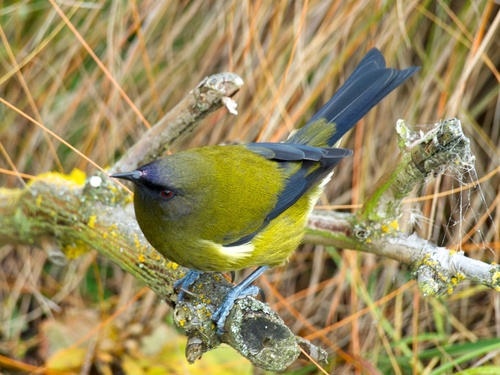
Anthornis melanura, commonly known as the New Zealand bellbird, is a medium-sized honeyeater. Adults measure 17–20 cm in total length from beak tip to tail tip; females average about 25 g in weight, while males average about 33 g. Males have an olive-green body with a dark purplish sheen on the head, with lighter coloring on the belly and flanks. The uppertail is black-brown, with a narrow iridescent blue-black edge on most feathers. Upperwing coverts are mostly dark olive-green, with blackish inner webs. The vent and undertail-coverts range from pale yellow to off-white, and the thighs are grey. The underwing is mainly grey with a dark olive leading edge, pale-yellow secondary coverts, and a brown tint on the remiges, with a distinct yellow patch at the bend of a folded wing. Male bellbirds have red irises. Females are slightly smaller than males, with duller, much browner plumage compared to adult males. Females have a bluish gloss on the head, and a narrow white stripe that runs from the gape and continues below the eye. Female upperparts are dark olive-brown with a dark brown uppertail and olive edges on the outer feather webs. The upperwing is mostly dark olive-brown with dark brown inner webs and olive outer edges. Underparts are mostly olive-brown, with a pale yellow feather patch on the flanks that is less prominent than in adult males; the vent and undertail-coverts are pale olive to off-white. The undertail is brownish grey, and the underwing matches that of an adult male. Female irises are brown. Bare part coloring is identical for both sexes: the bill is black and slightly curved downward, legs are grey-black, and claws are brown. Like other honeyeaters, bellbirds have a brush-like tongue adapted to collect nectar deep from within flowers. The tongue is longitudinally grooved, its tip is split into four segments, and the end of each segment has fine hair-like structures that form the final brush tip. In both sexes, the ninth primary feather is notched; sometimes the eighth, tenth, or all three of these primaries are notched as well. Two subspecies—oneho and obscura—are very similar in overall appearance to the nominate subspecies described above. Male A. m. oneho have more blue sheen on the head, and feathers on the nape, forehead, crown, ear coverts, chin, and throat have a violet sheen. Female A. m. oneho differ from nominate females by having a greener sheen on the head and neck, and a green-blue sheen on the crown, forehead, nape, and ear coverts. Compared to mainland nominate birds, A. m. oneho males are relatively larger in proportion to A. m. oneho females. Male A. m. obscura have slightly darker plumage than nominate males, and their upper body sheen is violet. Female A. m. obscura have slightly paler underparts than nominate females. Juvenile males are similar to adult males but have duller plumage with very little to no iridescence. Juvenile females are even paler and greyer than juvenile males. Unlike adult bellbirds, juveniles do not have notched primaries. Nestlings hatch without feathers, but quickly grow a covering of grey down. The most widespread subspecies by far is the nominate A. m. melanura, which occurs throughout New Zealand's North, South, Stewart, and Auckland Islands. It is also found on many satellite islands including Tiritiri Matangi Island, the Mokohinau Islands, Little Barrier Island, Cuvier Island, the Mercury Islands, the Hen and Chickens Islands, the Aldermen Islands, and Mayor Island. Vagrants have been recorded as far south as Campbell Island, and there is a historical 1888 record from the Snares Islands. Subspecies oneho occurs only on the Three Kings Islands, while subspecies obscura only nests on the Poor Knights Islands, and occasionally visits the nearby mainland of eastern Northland. Bellbirds are almost entirely absent north of Waikato. Northland gets occasional winter female visitors from nearby offshore islands, and small isolated populations exist in areas north of Auckland including the Tāwharanui Peninsula and Shakespear Regional Park. The species is also scarce in the Canterbury Plains and Central Otago. Within their native range, bellbirds can be abundant in native forest habitat, and are more widely distributed than tūī. Their habitat includes both native and exotic forests and scrublands, and they are frequently found in urban areas such as parks and gardens, especially where there is a nearby patch of native bush. They occur from lowland areas at sea level up to around 1200 metres elevation, including subalpine regions above the tree line. They thrive particularly well in densely vegetated areas, including mixed podocarp-hardwood lowland forests with diverse vegetation. They are typically found in forests dominated by northern rātā (Metrosideros robusta), tawheowheo (Quintinia serrata), kāmahi (Weinmannia racemosa), mixed southern beech forests (Nothofagus spp.), or coastal broadleaf forests such as those dominated by pōhutukawa (Metrosideros excelsa). They can also be found in exotic forests including eucalyptus, acacia, pine, and willow forests. Occasionally, they will venture into farmland, including orchards. Bellbirds typically reach higher population densities on predator-free islands than on the mainland. On the Poor Knights Islands, A. m. oneho was recorded reaching densities of 71 birds per hectare; this measurement came from a 0.45-hectare study area, so it may not accurately reflect density across the full 66-hectare island. On predator-free Great Island in the Three Kings Islands, bellbird density was estimated at 16 birds per hectare, and on Tiritiri Matangi Island it was 2.13 pairs per hectare. During the breeding season, bellbirds mostly stay within their territories, but may leave to feed at nearby food sources. Outside of the breeding season, they are solitary and nomadic. Bellbird flight is noisy and direct. Some populations are residential, while others make local migrations. Seasonal migrations have been recorded between inland bush in winter and summer coastal forest, or between river beds and urban areas. They are also able to move between offshore islands and the mainland. The bellbird population at Tawharanui is believed to have originated from birds that flew 23 km across open sea from Little Barrier Island. The main natural predators of bellbirds are the swamp harrier (Circus approximans) and the New Zealand falcon (Falco novaeseelandiae). In the Auckland Islands, bellbirds were the most common prey eaten by falcons. Bellbirds may also be attacked by introduced Australian magpies (Gymnorhina tibicen).