About Anthopleura thallia (Gosse, 1854)
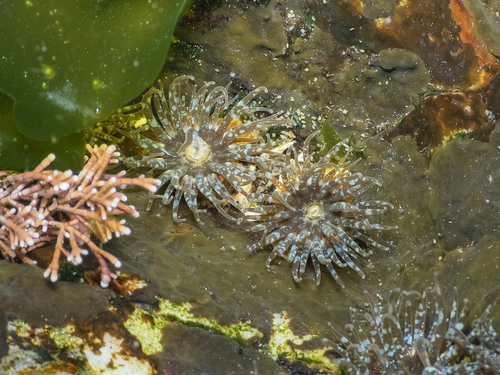
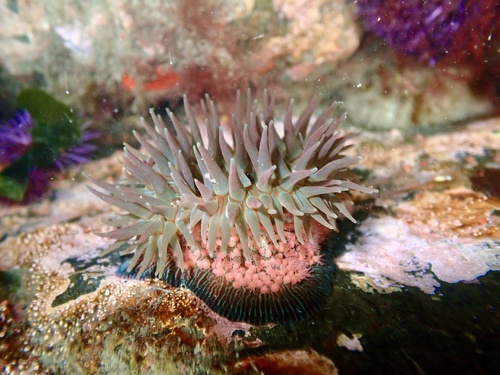
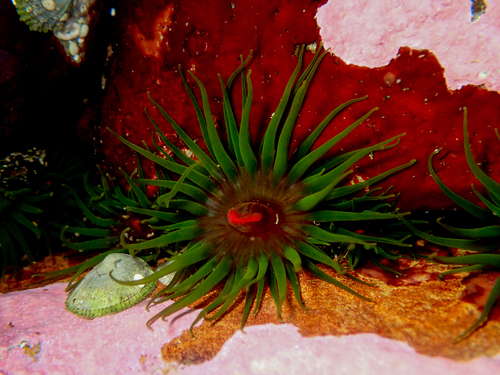
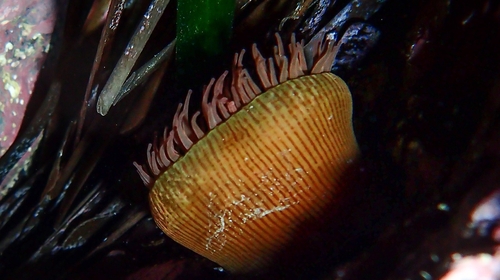
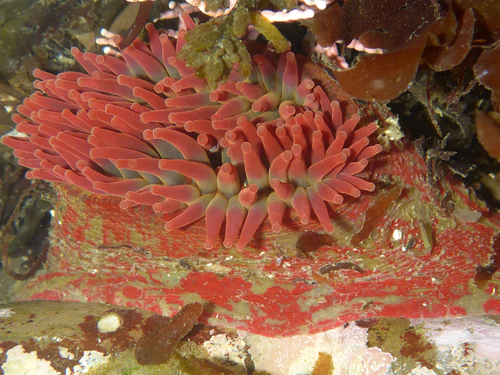
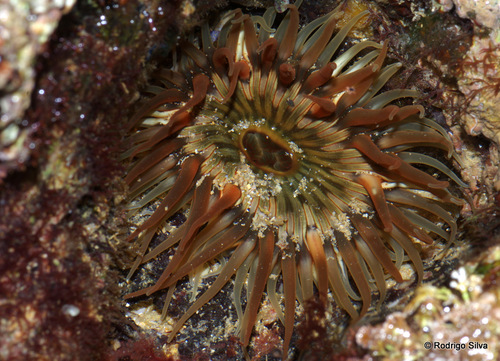
Anthopleura thallia typically has a base about 10 mm (0.4 in) wide, a column about 15 mm (0.6 in) long, and an oral disc 10 mm (0.4 in) wide. The lower section of the column has many sticky, cup-shaped warts arranged in roughly 36 vertical rows. The margin of the column bears several body-wall outgrowths called acrorhagi, which are heavily equipped with cnidocytes, also known as stinging cells. On the oral disc, there are two to four whorls of thirty to sixty tapering, blunt-tipped, fully retractile tentacles, surrounding a central mouth. The column of this sea anemone is green, yellow, or brown, and its warts range from red to brown, being darker than the column itself. The oral disc is green to brown, paler closer to the mouth, and marked with chevron-shaped patterns; the tentacles match the column's color, and sometimes have white barring. Anthopleura thallia occurs on the coasts of Western Europe and in the Mediterranean Sea. It is an uncommon species, and its confirmed range includes the Isle of Man, Ireland, southwest England, Normandy, Brittany, Galicia, Madeira, the Canary Islands, and the Mediterranean Sea. Reports of this species being present in Israel, the Red Sea, the Gulf of Aqaba, and Croatia are likely incorrect. It inhabits rocky coasts with strong wave action, ranging from the intertidal zone down to depths of about 25 metres (82 ft). Its column is often buried in sand, hidden in a crevice, found among mussels, or located under gravel, and usually has sediment particles or debris stuck to it. This trait helps distinguish Anthopleura thallia from its close relative the red speckled anemone (Anthopleura ballii), which has a non-adhesive column.