About Anthopleura sola Pearse & Francis, 2000
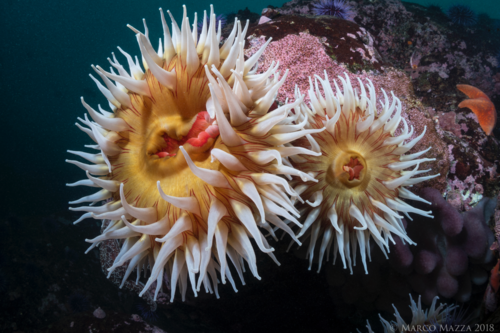
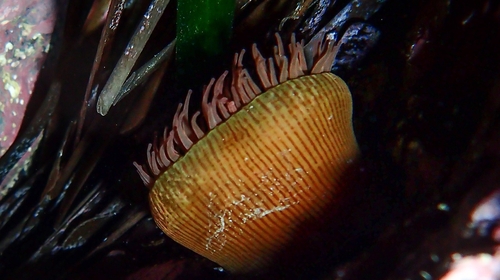
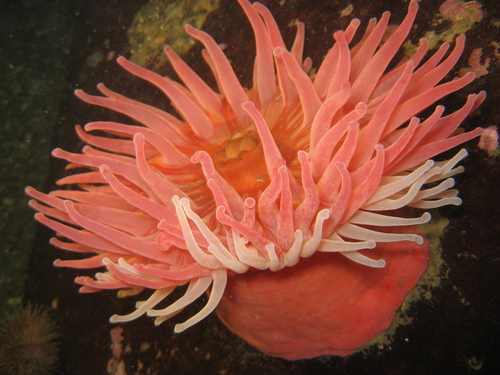
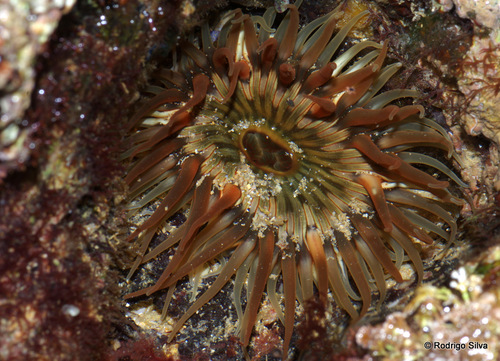
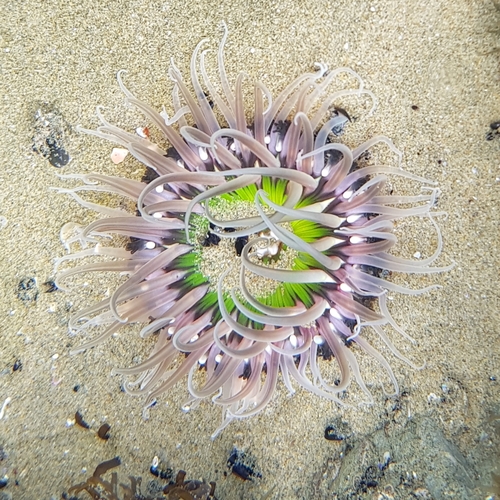
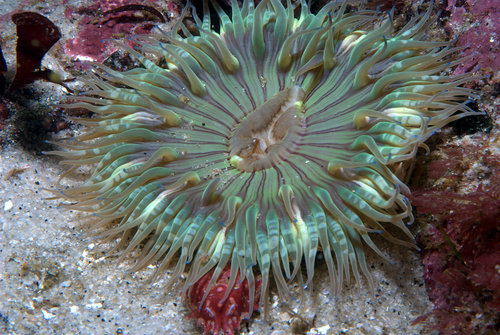
Anthopleura sola, commonly known as the sunburst or starburst anemone, is a solitary sea anemone species. Individuals average 12 cm (4.7 in) wide and can grow up to 25 cm (9.8 in) wide, making it much larger than the closely related aggregating anemone Anthopleura elegantissima. When extended, its column is pale green to white, and twice as long as it is wide. The column bears numerous sticky protuberances called verrucae, arranged in vertical rows; gravel and shell fragments commonly adhere to these verrucae. Its oral disc has radial stripes, and features five rings of thick, pointed feeding tentacles. The tentacles are pale, with tips colored pink, blue, or lavender. This species displays a wide variety of color patterns on its tentacles and oral disc. Pale tentacle tips occur when anemones frequently shelter under rocks or in shaded areas, as low light prevents the development of green pigments; striped patterns on tentacles are the result of genetic differentiation. Though morphologically similar to the aggregating anemone Anthopleura elegantissima, the sunburst anemone can easily be distinguished by its solitary nature. A. elegantissima is highly clonal and almost always found in dense groups of clones, while A. sola is non-clonal and typically solitary. It can be differentiated from Anthopleura xanthogrammica by its tentacle tip coloration, striped oral disc, and vertical rows of verrucae. The anemone's color is partially produced by symbiotic zooxanthellae that live in its gastrodermal layer. This species reproduces sexually. The sunburst anemone is found in the northwest Pacific Ocean, occurring along the United States coast from central California to Baja California. It inhabits the lower intertidal zone of rocky habitats, often sheltering inside cracks and crevices. It also occurs in the subtidal zone, commonly in kelp forests, to depths of at least 20 m (70 ft). When the tide is out, the anemone folds its column into an encrusted ball, often concealed by the shell fragments and other particles that adhere to it. The encrusted column may provide camouflage from predators, as well as protection from solar radiation and desiccation. This anemone forms a symbiotic partnership with Breviolum muscatinei, a dinoflagellate in the family Symbiodiniaceae. This relationship is of scientific interest because the geographic range of Anthopleura sola is currently expanding northward. As the sunburst anemone moves north, it forms new symbioses with B. muscatinei, which has historically only formed partnerships with other anemone species, including A. elegantissima and A. xanthogrammica. The sunburst anemone acts as a host for this photosynthetic alga. Their relationship is a nutritional exchange: the host anemone receives photosynthetically produced sugars from the algae, while the algae receive metabolic waste nutrients from the host, as well as a protected location with access to sunlight. This symbiotic relationship can collapse under environmental stress such as temperature changes, which causes bleaching and can lead to the death of the host anemone. Local populations can adapt to develop resistance to this collapse, but this inherited adaptation is only maintained if offspring remain in a similar environment. Even though the sunburst anemone and B. muscatinei partner symbiotically, each species has its own separate life cycle with distinct patterns of reproduction and migration.