About Anthopleura artemisia (Pickering, 1846)
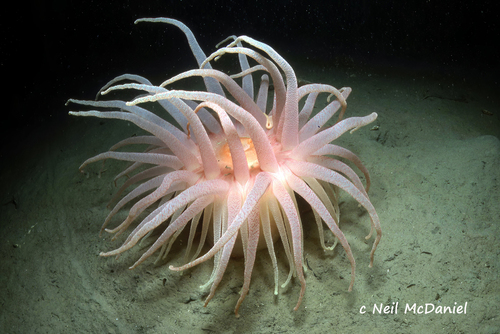
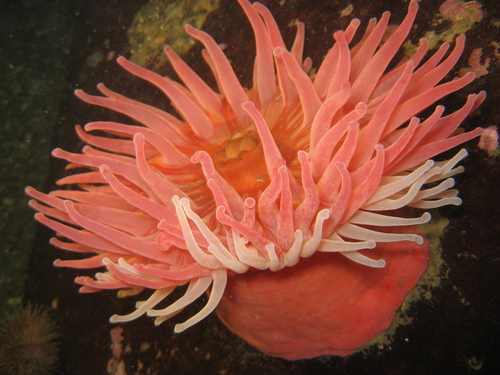
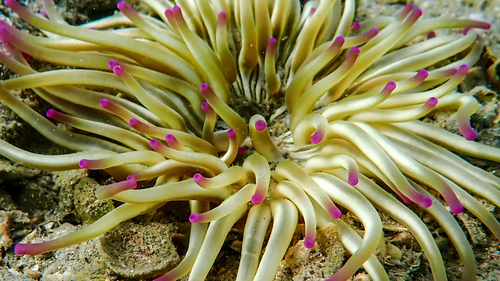
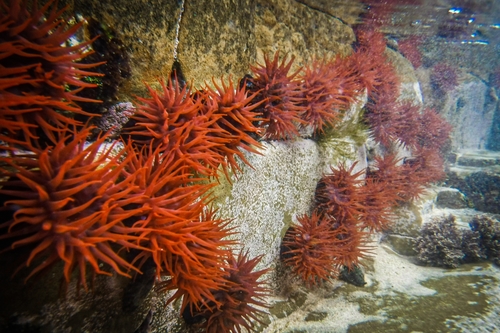
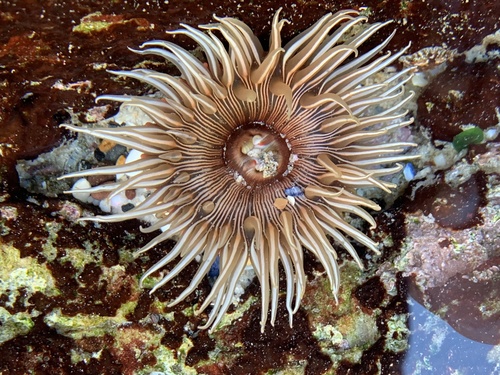
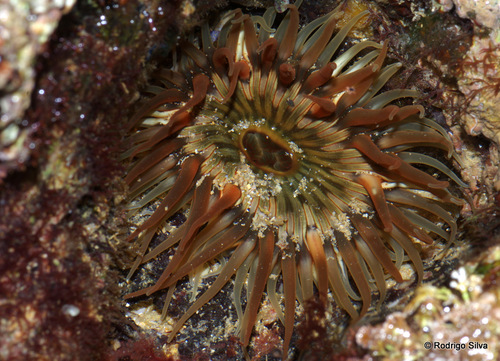
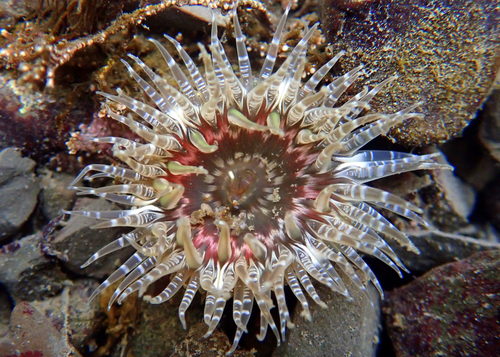
Commonly called the burrowing anemone, this species (Anthopleura artemisia) usually has its column buried to some degree. In some individuals, the entire column may be buried, with only the oral disk and tentacles visible above the surface. The buried section of the column is pink or white, while any part that sits above the substrate is green or brown. When including the buried portion, the column can reach a maximum height of 25 centimetres (9.8 in) and a maximum diameter of 10 centimetres (3.9 in). The upper third of the column is covered in longitudinal rows of rounded, wart-like tubercules. These tubercules are sparse on the middle third of the column, and are usually absent on the lower third. The tentacles are slim and tapering, reaching a length about half the width of the oral disk. Both the tentacles and oral disk vary in color between individuals, and can be green, brown, black, pink or orange. The tentacles are often marked with white bands. There are rarely more than five rows of tentacles circling the oral disk. This species has specialized fighting tentacles called acrorhagi, which it uses to attack other anemones that grow too close. When not inflated for an attack, these acrorhagi are not easy to see. They form a single row of round, white bumps located underneath the outer row of tentacles. Burrowing anemones are often solitary on the open coast, and live in closer groups in estuaries. This anemone prefers to live on loose sandy, shelly, muddy, or cobbled bottoms that allow it to bury itself. It requires a solid object such as a rock at the base of this loose layer to anchor its column. This species has been recorded living in holes bored by clams. It is a shallow water species that lives from the intertidal zone down to a depth of 30 metres (98 ft). It prefers sheltered bays over open ocean beaches, and has been found attached to pilings and floats. This species can be found from Alaska to southern California, including Puget Sound. The type specimen referenced for the original species description came from Discovery Bay, Washington.