About Anthophila fabriciana (Linnaeus, 1767)
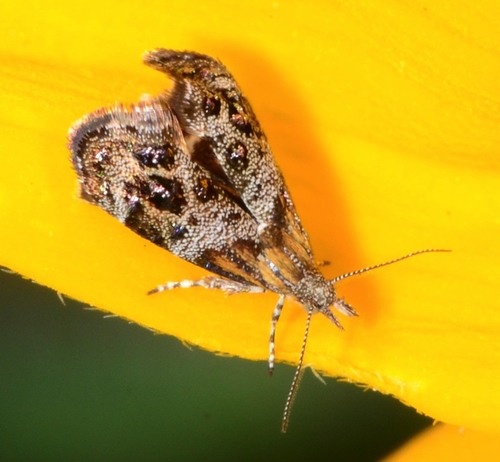
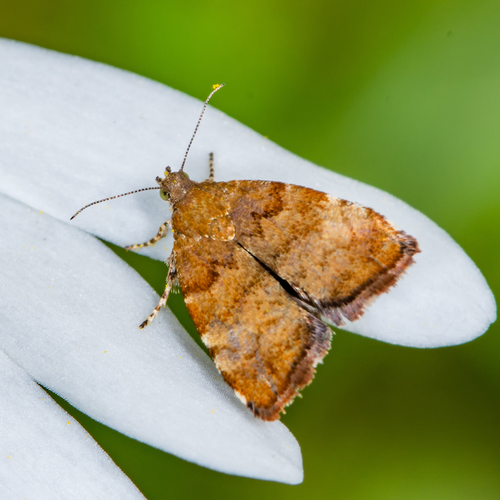
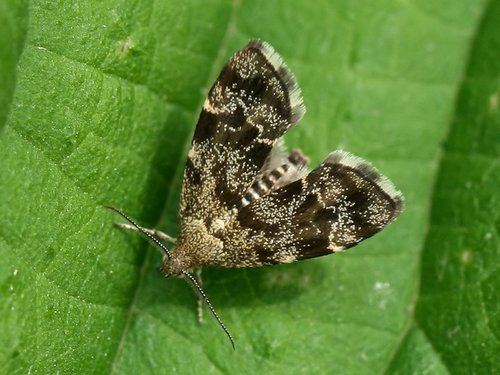
Anthophila fabriciana, first described in 1767 by Carl Linnaeus, is a moth in the family Choreutidae, and is commonly known as the common nettle-tap. This day-active moth flies around stinging nettles during the daytime, and can be found anywhere stinging nettles grow. The species is distributed across most of Europe, throughout Britain, and has a widespread range that covers China (Taiwan and Xinjiang), the Himalaya, Mongolia, Russia, Korea, Japan (Hokkaido, Honshu, and Shikoku), Afghanistan, Kazakhstan, the Canary Islands, Madeira, Asia Minor, Zakavkazye, and the Oriental region. In 2013, the species was confirmed to be present in Manitoba, Canada. This moth has an annual life cycle with two generations per year, active from May to October, though exact timing varies by location. Some adult individuals overwinter. The wingspan of Anthophila fabriciana measures 10–15 millimetres (0.39–0.59 in). Its forewings form a patchwork of dark brownish fuscous marbled with pale grey, and feature a yellowish white costal spot and post-median fascia. The abdomen bears large pale bands. This species looks quite similar to Choreutis pariana, which differs by only having whitish markings along the costa.