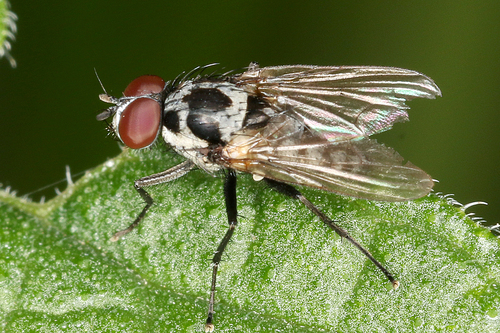
About Anthomyia procellaris Rondani, 1866
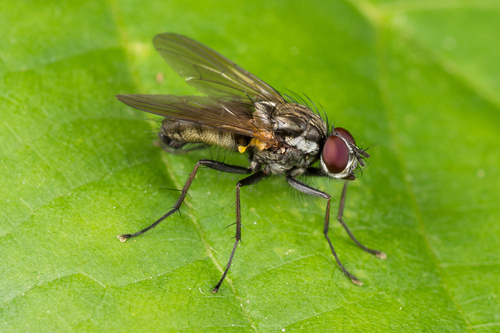
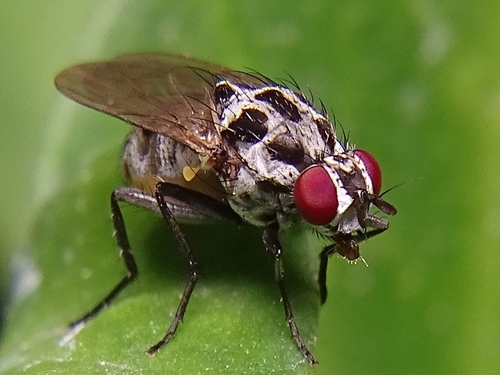
Anthomyia procellaris Rondani, 1866 is a small fly that reaches a body length of 5–7 millimetres (0.20–0.28 in). Individuals of this species have velvety black markings on a greyish background, with three black spots on the center of the thorax. Their eyes are bare, and their proboscis is robust. The abdomen is mainly greyish. This species is very similar to Anthomyia imbrida and Anthomyia pluvialis, making it quite difficult to correctly identify. A distinguishing feature of Anthomyia procellaris is that the black marking located just at the base of the wings is not split into two separate areas, and it ends at a straight rear boundary. Additionally, in male individuals of this species, the number of anterodorsal hairs on the hind tibia is fewer than 9. This species is distributed across Europe, the East Palearctic realm (including China and Japan), the Near East, and the Nearctic realm (ranging from Michigan south to North Carolina). These flies favor wooded habitats and hedge rows. They are active from spring through autumn and enjoy sun bathing. They feed on nectar, pollen, and excrement. Their larvae are associated with bird nests, where they feed on bird droppings.