About Anthocharis midea (Hübner, 1809)
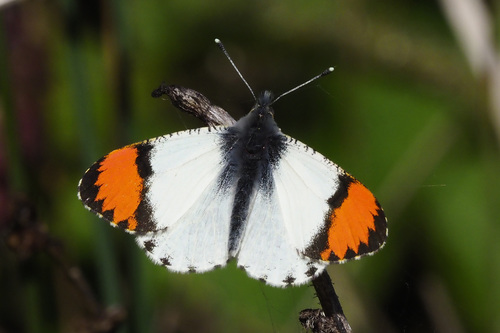
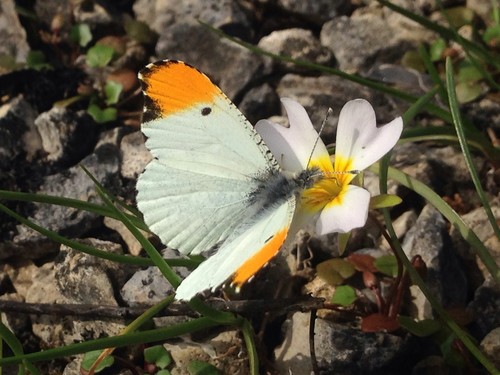
This species, Anthocharis midea, has distinct wing traits across sexes. The tip of the upper forewing of males is orange, while females do not have this orange patch. Both sexes have a round black spot in the forewing cell. The underside of the hindwing usually has detailed, complex green marbling patterns. Adult orangetips of this species have a wingspan of approximately 3.5 to 4.5 centimeters. In its life cycle, males patrol hilltops and open flats throughout the day searching for females. Females lay eggs one at a time on the flowers of host plants. Newly laid eggs are yellow-green, but turn red just before larvae hatch. Larvae feed mainly at night, and prefer eating flowers, flower buds, and seed pods over leaves. They are also cannibalistic, and will eat smaller larvae that are feeding on the same host plant. Full grown larvae reach up to 3 centimeters in length. The larva is olive green with a yellow mid-dorsal stripe, plus a white spiracular stripe that runs the full length of its body. Its body is covered in short hairs and tiny black dots. Larvae pupate in mid-June. The chrysalis is yellowish with black spots, and has a spike-like projection on the head that gives it a thorny appearance. Chrysalids can overwinter for two or more years, and the species produces only one brood per year.