About Anthocharis euphenoides Staudinger, 1869
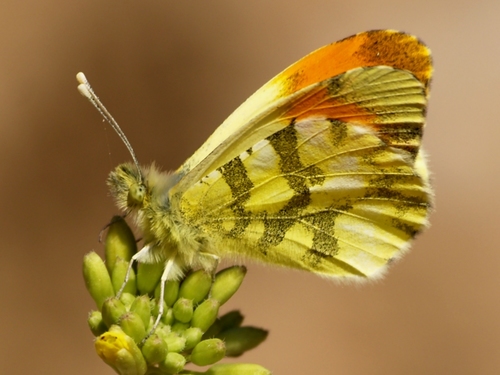
This butterfly species Anthocharis euphenoides Staudinger, 1869 displays very prominent sexual dimorphism. Males are yellow, with orange forewing apices bordered by a narrow black band, while females are white, with orange forewing apices and the same black band. On the underside, the hindwings have green markings; the underside of the forewing apex is orange in males and yellow in females. In Seitz's description, A. euphenoides can be distinguished between the sexes solely by the color and markings of the underside of the hindwing. The color of the apical area on the upperside of the forewing is highly variable in females, and some female specimens have a rather large reddish yellow patch in this area. The aberration ab. lecithosa Tur., which has so far only been recorded in South France, lacks an orange patch in males, and instead has a sulphur-yellow apical spot matching that of the species' female form. The larva is greenish, with yellow and black dorsal markings, white lateral stripes, and large black dots, and has a green head. Larvae feed on Biscutella species in autumn, and are categorized as so-called cannibal caterpillars. The pupa can be light brown or green, and is very strongly incurved, according to Spuler.