About Anthocharis cardamines (Linnaeus, 1758)
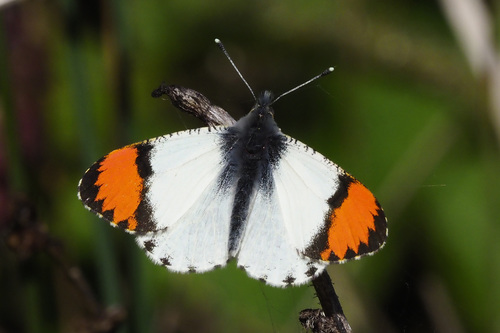
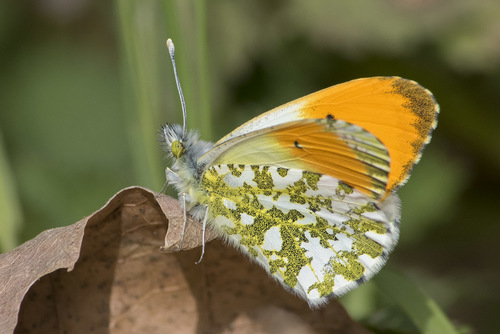
This species, commonly known as the orange tip, gets its common name from the bright orange wing tips on the forewings of males. Males are a common sight during spring, flying along hedgerows and damp meadows to find the more reclusive females. Females lack the orange wing tips and are often mistaken for other butterfly species. The undersides of the wings are mottled green and white, which creates excellent camouflage when the butterfly rests on flowerheads such as cow parsley and garlic mustard (Alliaria petiolata). Male orange tips show body size variation that is linked to the host plant they were reared on. Males raised on C. pratensis develop into the smaller size variant, while those raised on A. petiolata develop into the larger variant. Anthocharis cardamines is distributed across Europe, and extends through the Palearctic region all the way to China. The habitats used by males and females differ significantly. Males stay restricted to forest edges and forest clearings for their entire lives. On rare occasions, males will leave forest edges to enter meadows, but only to cross through to reach another forest edge. They prefer to fly in bright sunlight and avoid shaded areas within forests. For most of their lives, females are primarily found in open meadows and dry hillocks. Females only spend short periods of time in forests before returning to nearby meadows. In Armenia, this species inhabits both forests/woodlands and meadows, where males and females occur together. Recorded flower resources used by females include Lathyrus montanus, Viola canina, Viola riviniana, Geranium robertianum, Viola tricolor, Capsella bursa-pastoris, and Lychnis flos-cuculi. Female A. cardamines feed on these listed flowers, as well as any other flower species growing in the same habitats as their host plants. They do not pause their search for host plants to seek out separate foraging habitats; instead, they simply visit the flowers already available in host plant habitats.