About Anthochaera carunculata (Shaw, 1790)
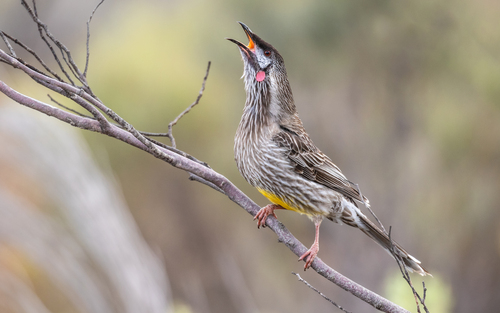
The red wattlebird (Anthochaera carunculata) has sexes that are similar in size and plumage. Adult males measure 33 to 37 centimetres (13 to 15 inches) in length, while adult females measure 34 to 37 centimetres (13 to 15 inches). With an average weight of 100–120 grams (3.5–4.2 oz), the red wattlebird is one of the largest nectar-feeding birds in the world, and the second largest honeyeater native to Australia — only the yellow wattlebird is larger. Its crown, forehead, and upper lores (the area between the eyes and nostrils) are dark brown, with pale brown streaks on the front of the crown and white streaks on the rear of the crown. The nape (back of the neck) is a slightly paler brown, with white streaks. A whitish triangular marking covers the lower lores and anterior ear covert feathers, bordered below by a dark brown stripe that runs from the lower mandible down to the wattle and around to behind the eye. The throat is dark brown with white streaks, and the iris ranges from orange-red to crimson. Distinctive pinkish-red wattles dangle from the lower rear corner of the ear coverts on either side of the neck, and there is a thin strip of pink bare skin at the lower edge of the white facial patch. The chest and belly have white streaks, and there is a bright yellow patch towards the tail. The strong legs and feet are pink or pinkish-brown, and the downward-curving bill is black. The average dimensions of the bill are 23.5 millimetres (0.93 in) long, 6.7 millimetres (0.26 in) wide, and 6.8 millimetres (0.27 in) high at its base. The gape is grey-black, while the inside of the mouth is orange. Like other honeyeaters, the red wattlebird has a long, specialized tongue to extract nectar from flowers. The tongue can extend well past the tip of the bill, and is split at the end to form a brush-like structure with over a hundred bristles that soak up nectar via capillary action. The red wattlebird starts moulting after the breeding season, beginning with primary flight feathers in November or December, and finishing moulting between the following March and May. Feathers of the breast, back, and median and lesser covert feathers are moulted before the feathers of the crown, remiges, and rectrices. Immature red wattlebirds are generally less boldly marked than adults. Juveniles have much less prominent wattles, brown irises, a pale crown, and far less yellow on the belly. They moult into first immature plumage within a few months of leaving the nest. First immature birds are overall more similar to adults, with red irises marked by brown rings, wattles that are larger than juveniles but still smaller than adults, and a greyish pink gape. The red wattlebird is unlikely to be confused with other species, though it may be mistaken for the spiny-cheeked honeyeater, or the little or western wattlebird in poor visibility. In terms of distribution and habitat, the red wattlebird is found in southeast Queensland, where it occurs south of Noosa and Cooloola, and becomes more common south of Brisbane and Toowoomba. Further south into New South Wales, it occurs across most areas east of and including the Great Dividing Range, stretching west to the southern North-West Plain, Central Western Slopes and eastern Riverina, and is an occasional visitor to locations along the Murray River valley. It is found across Victoria, though it is uncommon in the northwest of the state. In South Australia, Devonborough Downs Station, Manunda, Wilpena Pound and Nullarbor Station mark the northern limits of its range. There are scattered records from the Nullarbor Plain, but the species is common in Western Australia west of 125 °E and south of 29 °S. The yellow wattlebird replaces the red wattlebird in Tasmania. The red wattlebird has become more common in some localities, including the Sunraysia district in the 1960s, and Nambucca Heads and Lefevre Peninsula in the 1980s. Breeding numbers have increased in Sydney and Adelaide. The red wattlebird is a rare vagrant to New Zealand, with confirmed records from Matakana in 1865 and Rohutu, Taranaki, in 1885, and a third unconfirmed report from Motupiko in 1938. The red wattlebird appears to be a permanent resident across much of its range, though its movements are poorly understood. It appears to be partly migratory in Western Australia and on the north coast of New South Wales. In southeastern New South Wales and the Australian Capital Territory, it appears to move to lower altitudes for winter; for example, birds leave the Brindabella Range over the cooler months. Overall, little clear pattern is visible in the species' movements, though red wattlebirds do appear to move to feed on flowering populations of banksias and eucalypts, such as winter-flowering banksias in Perth over the cooler months. Large numbers arrive to feed on flowering native apples (Angophora) in the Mudgee and Cobbora districts of central-western New South Wales, and on white box (Eucalyptus albens) at Barrington in central-northern New South Wales. A mainly resident population on the Swan Coastal Plain near Perth is joined during winter by more individuals arriving from inland areas. South of Perth, red wattlebirds are more locally nomadic, moving to new patches of blooming wildflowers. East of Perth in areas around Kellerberin, Kwolyin, and Nangeenan, the red wattlebird is present from late autumn to spring, and breeds in August and September. Around Lake Grace, the red wattlebird is present year-round. Open sclerophyll forest and woodland, generally dominated by eucalypts, is the species' most common habitat. It is more common in forests with abundant shrubby or grassy understory. It is less commonly found in shrubland, heath, or the margins of wet sclerophyll forest. It is rarely found in mature pine plantations. Within urban areas, it is abundant in parks and reserves, gardens and golf courses, as well as orchards and vineyards. It occasionally enters subtropical, semi-arid or subalpine regions, and has been recorded up to 1,900 m (6,000 ft) above sea level. The red wattlebird is rarer in forests that have been affected by dieback caused by infection by the pathogen Phytophthora cinnamomi.