About Anthobaphes violacea (Linnaeus, 1766)
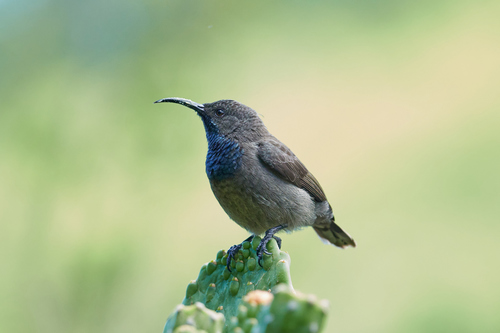
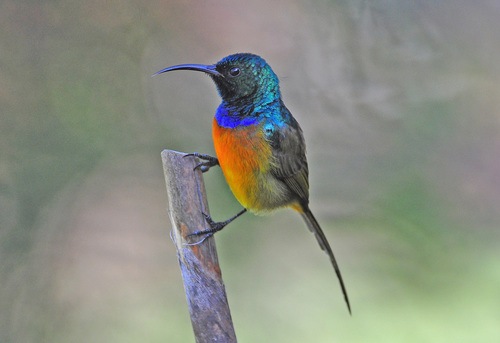
Like other sunbirds, Anthobaphes violacea has a long, decurved bill; the male's bill is longer than the female's. The bill, legs, and feet of this species are black, and the eyes are dark brown. Males have bright metallic green coloring on the head, throat, and mantle, with the rest of the upper parts being olive green. The upper breast is metallic violet, the lower breast is bright orange, and the color fades to paler orange and yellow on the belly. The tail is long and blackish, with elongated central tail feathers that extend beyond the other tail feathers. Females have olive-greenish grey upperparts and olive yellowish underparts, which are paler on the belly. The female's wings and tail are blackish. Juvenile birds resemble females. The species' call is a twangy, weak ssharaynk or sskrang, which is often repeated several times. This sunbird has a restricted range within the fynbos biome of South Africa's Western Cape, and it is associated with ericas and proteas. It breeds when heath flowers, typically in May. Males defend their territories aggressively, attacking and chasing intruders. This is a tame species that is a common breeder across its limited range. It is an altitudinal migrant, moving to higher altitudes during the southern summer to search for flowers. When not breeding, it is gregarious, forming flocks of up to 100 birds. Anthobaphes violacea, commonly called the orange-breasted sunbird, is known to pollinate Protea, Leucospermum, and Erica species, whose flowers it visits for nectar. It perches on the ground to access the low flowers of Hyobanche sanguinea and Lachenalia luteola. It also engages in nectar theft from flowers with longer corolla tubes such as Chasmanthe floribunda. The fynbos habitat is fire-prone, which encourages a great amount of mobility in these birds; this may have contributed to a greater level of individual genetic variability, despite the species having a rather limited distribution range. A number of plasmodia-like blood parasites have been recorded from orange-breasted sunbirds. The orange-breasted sunbird feeds primarily on flower nectar, predominantly from ericas and proteas, though it will also use nectar from other types of flowering plants. It also eats small insects and spiders, which it often catches in flight.