About Anthias anthias (Linnaeus, 1758)
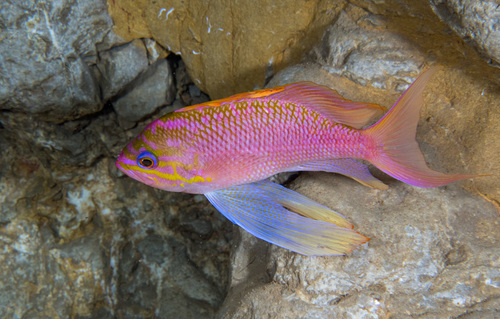
Anthias anthias (Linnaeus, 1758) has a relatively deep body: its standard length is 2.5 times its body depth. The dorsal fin has 10 spines (with the third spine being particularly long) and 15 soft rays. The anal fin has three spines and seven soft rays. Pectoral fins are longer than pelvic fins. The caudal fin has asymmetrical, pointed lobes, and the lower lobe is longer than the upper lobe. This species has a complete lateral line with 36–39 large scales. Its body color ranges from pink to red, and it has three yellow lines on the sides of its head. It often develops brown blotches along its back. Pelvic fins are naturally yellow, but the pelvic fins of breeding males turn red. The maximum recorded standard length of this species is 27 centimetres (11 in), while most adults measure between 12–18 centimetres (4.7–7.1 in). Anthias anthias was first formally described in 1758 by Carolus Linnaeus as Labrus anthius in the tenth edition of Systema Naturae, Volume 1, with its type locality given as southern Europe. When Marcus Elieser Bloch established the genus Anthias, he named Anthias sacer as the type species. However, A. sacer is now considered a synonym of Linnaeus's Labrus anthias, meaning this species is the type species of the genus Anthias. The specific epithet anthias comes from Greek, where it refers to a type of fish, most likely the gilt-head bream. This species is found in the eastern Atlantic Ocean and the Mediterranean Sea. In the eastern Atlantic, its range extends from Portugal south to Angola and northern Namibia. It is also present around the Azores, Madeira, the Canary Islands, Cape Verde Islands, and the islands of the Gulf of Guinea. It is widespread across the Mediterranean, and has been recorded in the Canakkale Strait off Gallipoli, but does not occur in the Black Sea. Anthias anthias lives at depths between 15 and 200 metres (49 to 656 ft), among rocks and corals, and hides in caves during the day. It emerges at night to feed on zooplankton, small crustaceans, and small fish. This species is a protogynous hermaphrodite: all individuals hatch as female. When a male in a group dies, one of the larger females changes sex to become a male. Most individuals remain female for their entire lives, and even large schools of this species only contain a small number of males. The sex change process takes approximately two weeks, and involves changes not just to gonads, but also to body color, size, and shape. If a social group ends up with too many males, some males can reverse the sex change and revert to being female. These fish have been observed feeding co-operatively: some individuals feed while others herd prey such as shrimp, and the fish reverse roles to let all individuals feed.