About Antheraea yamamai Guérin-Méneville, 1861
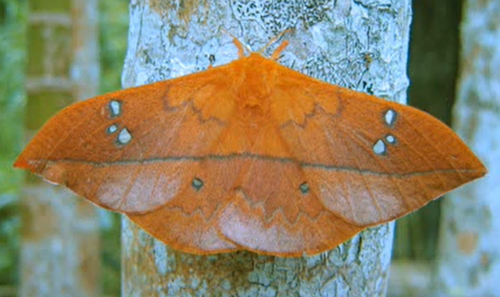
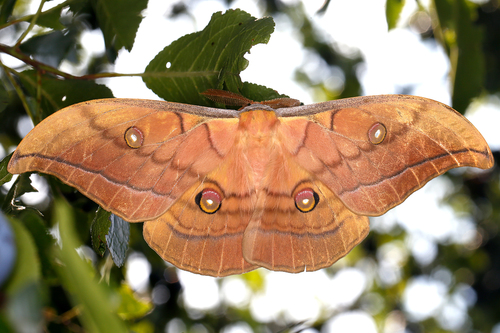
Antheraea yamamai, commonly called the Japanese silk moth or Japanese oak silkmoth, is known in Japanese as yamamayu(ga) (written 山繭(蛾), ヤママユ(ガ)) or tensan. It is a moth species belonging to the family Saturniidae. It is naturally endemic to East Asia, but was imported to Europe for tussar silk production, and is now established in southeastern Europe, found primarily in Austria, northeastern Italy, and the Balkans. The species appears to be spreading northward, and a population has been recorded near Deggendorf and Passau in Germany. Antheraea yamamai was first formally described by Félix Édouard Guérin-Méneville in 1861. It has been artificially hybridized with Antheraea polyphemus, a related saturniid moth species native to North America. This moth has been cultivated in Japan for over 1000 years. It produces a naturally white silk that is very strong and elastic, but it does not take dye well. As a result, tensan silk is now very rare and expensive. The wingspan of adult Antheraea yamamai ranges from 110 to 150 millimetres, or 4.3 to 5.9 inches. Depending on location, adults have a single generation per year and are active on the wing from August to September. Larvae feed primarily on oak (Quercus) species, but have also been recorded feeding on Fagus sylvatica, Castanea sativa, Carpinus, Rosa, and Crataegus. To enable more detailed study of tensan silk genes, a de novo genome and set of transcriptomes of the species have been sequenced, resulting in a 700Mb reference genome that contains 15,481 annotated genes.