About Antheraea polyphemus Cramer, 1775
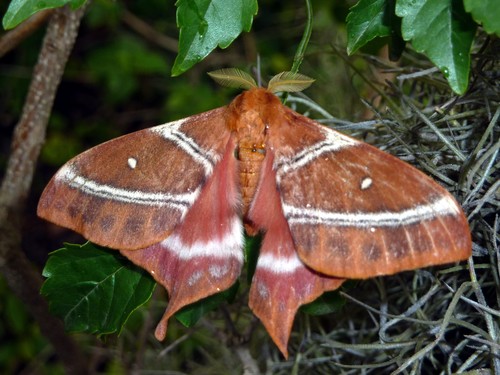
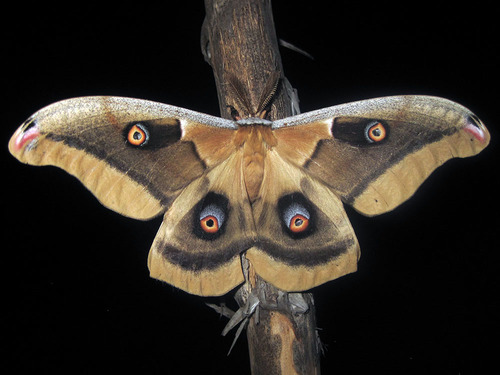
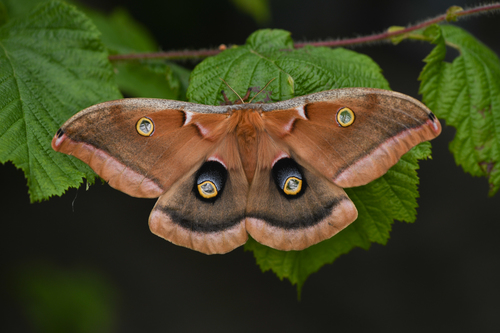
Antheraea polyphemus, commonly known as the Polyphemus moth, is a North American species in the Saturniidae family of giant silk moths. This tan-colored moth has an average wingspan of 15 cm (6 in). Its most prominent feature is large, purplish eyespots located on its two hindwings; these eyespots inspired the species name, taken from the Greek myth of the cyclops Polyphemus. The species was first described by Pieter Cramer, with the official scientific naming dated to 1775. The Polyphemus moth is widespread across continental North America, with local populations ranging from subarctic Canada through most of the United States. It occurs in every U.S. state except Arizona and Nevada. Its habitats include deciduous hardwood forests, orchards, urban areas, and wetlands. Over roughly 56 days, a little less than two months, a Polyphemus moth caterpillar can consume 86,000 times its starting weight when it first emerges. This species is highly polyphagous, meaning it feeds on a wide variety of different plants. Its life cycle follows the typical pattern for other Saturniidae species. Adult females lay flat, light-brown eggs on the leaves of various host trees, with a preference for Ulmus americana (American elm), Betula (birch), and Salix (willow). More rarely, caterpillars can survive on other tree species, including Quercus (oak), Acer (maple), Carya (hickory), Fagus (beech), Gleditsia triacanthos (honey locust), Juglans (walnut), Pyrus (pear), Prunus (plum, peach, apricot, cherry, and similar species), Sassafras, and Citrus. Polyphemus moths mate on the same day they emerge from their cocoons. Mating can last anywhere from less than an hour to multiple hours. Shortly after mating, females begin laying their eggs. If a female cannot find a male, she stops releasing mating signals after 2–3 days and lays her unfertilized eggs. In most regions, females lay up to 5 eggs total, either singly or in small groups of 2 or 3 on the undersides of tree leaves. When eggs hatch, small yellow caterpillars emerge. As caterpillars grow, they molt five times, with the fifth molt resulting in development into a pupa. Each larval instar differs slightly, but by the fifth and final instar, caterpillars turn bright green with silver spots along their sides. They feed heavily on their host plant and can reach 3–4 inches in length when fully grown. Next, caterpillars spin brown silk cocoons, usually wrapped in host plant leaves for extra protection and camouflage. The pupa is anchored to a loosely spun silk pad at the end of the cocoon by a cremaster. The adult moth will later emerge through this end of the cocoon from the pupal exoskeleton as the pupa completes its transformation into an adult moth. The adult emerges by splitting the pupal exoskeleton at its anterior end and pushing the top open. Most areas of the United States see two broods of Polyphemus moths each year: one hatching in early spring and a second in late summer. Emergence typically happens in the afternoon, and males usually emerge several days earlier than females from the same brood. After emerging (eclosing), adult moths must pump fluid called hemolymph into their wings to fully extend them. Newly emerged females release pheromones to attract male mates. These sex-attractant pheromones start being released in the late evening of the day the female emerges, and can draw males from far away. Maximum male attraction occurs during the two hours just before sunrise. Males detect these pheromones using specialized sensory structures called trichoid sensilla on their antennae. These hair-like structures hold 1–3 pheromone-responsive neurons, which extend their sensory dendrites into the sensillum shaft, a sensory organ that protrudes from the moth’s cuticle. Males can fly miles to reach a receptive female. As a mostly nocturnal species, adult Polyphemus moths become active at dusk and through the night while searching for mates. After mating, females spend most of their remaining lives laying eggs, while males may mate several additional times. Adult moths in the Saturniidae family have vestigial mouths, meaning their mouthparts are greatly reduced. As a result, adult Polyphemus moths cannot feed and only live for less than one week as adults. In captivity, this species is much harder to breed than other North American saturniids such as Hyalophora cecropia, Callosamia promethea, or Actias luna. When kept in a cage, males and females typically ignore each other unless a food plant, especially oak leaves, is present.