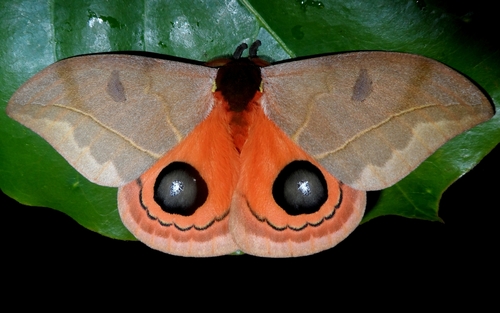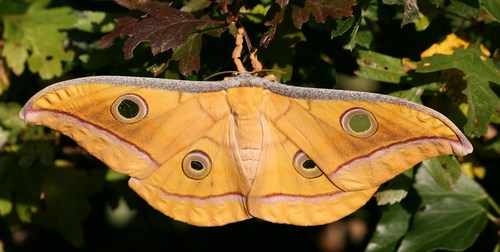
About Antheraea paphia Linnaeus, 1758
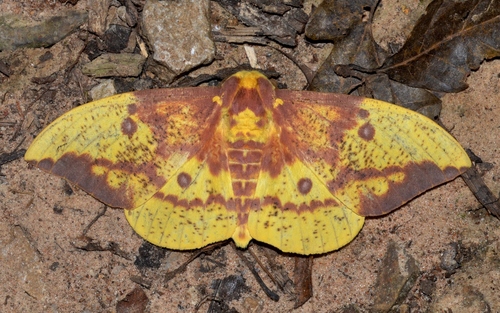
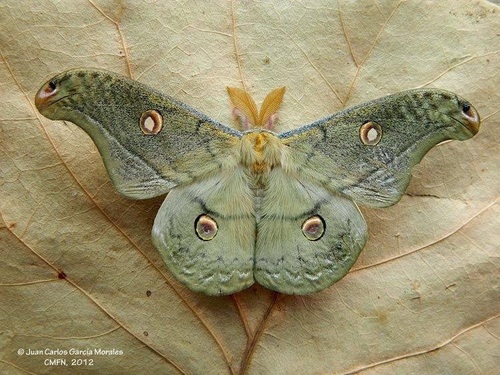
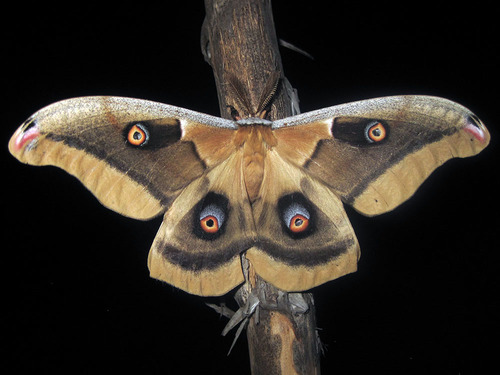
Male Antheraea paphia are reddish or yellowish. A brown and grey band along the costal edge of the forewings extends to the wing apex. The transparent, eye-shaped (ocellated) spots are much larger than the corresponding spots on Antheraea roylei. On the hindwings, the submarginal line sits close to the wing margin, and no marginal yellow line is present. Females are typically pinkish-brown or bright yellowish fawn, and their transparent ocellated spots are larger than those of males. Larvae are green, with a paired dorsal series of yellow humps. White crescent-shaped spots on the fifth and sixth body segments have purple borders; a lateral yellow line that starts at the seventh segment ends in a widened brown band on the anal segment. The spiracles are yellow. The cocoon is brownish grey, hard, and oval, and attaches to the host plant via a stalk-like silken peduncle. Larvae of this species feed mainly on Terminalia trees, such as Terminalia tomentosa and T. arjuna, as well as Shorea robusta. They also feed on many other plant types, with different locally adapted populations (ecoraces) specializing on specific plant groups. Additional recorded host plants include Indian jujube (Ziziphus mauritiana), axlewood (Anogeissus latifolia), jambul (Syzygium cumini), Madhuca indica, kumbi (Careya arborea), anjan (Hardwickia binata), and species of teak (Tectona spp.) and crepe myrtle (Lagerstroemia spp.). Tussar silk produced by this and related wild silkworm species differs in color from silk from domesticated silkworms, and is coarser and stronger, making it preferred for certain uses. Like domesticated silkworms, A. paphia is susceptible to pébrine, a disease caused by microsporidian fungi in the genus Nosema, which is lethal to larvae. The species is also commonly infected with Antheraea mylitta cytoplasmic polyhedrosis virus (AmCPV), a cypovirus. This virus is reported to destroy around 20% of every silk crop by causing diarrhea in larvae, leading to a condition known as grasserie. A key natural enemy of this silkworm is the uzi fly (Blepharipa zebina), a parasitoid whose maggots feed on A. paphia larvae. Many of the species' ecoraces are threatened as a result of extensive deforestation and widespread collection of cocoons from wild populations.