About Antennatus tuberosus (Cuvier, 1817)
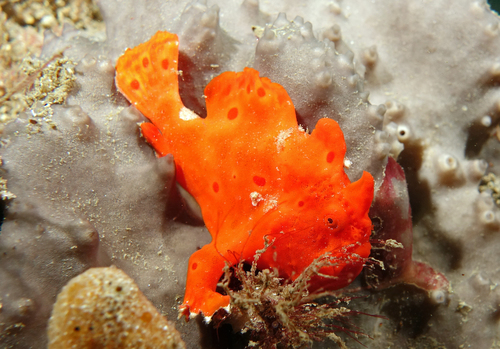
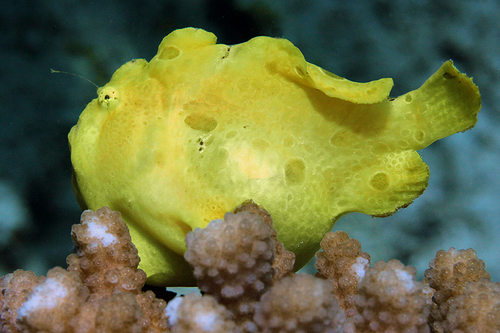
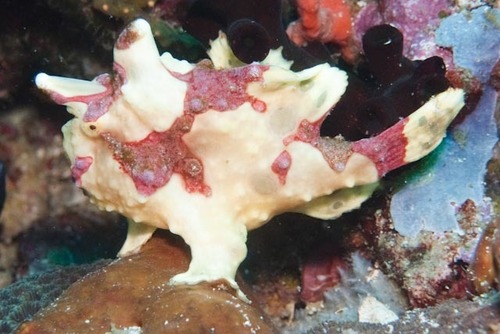
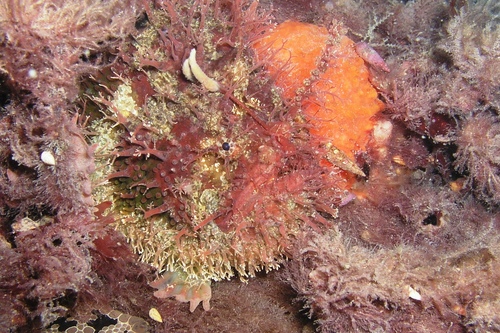
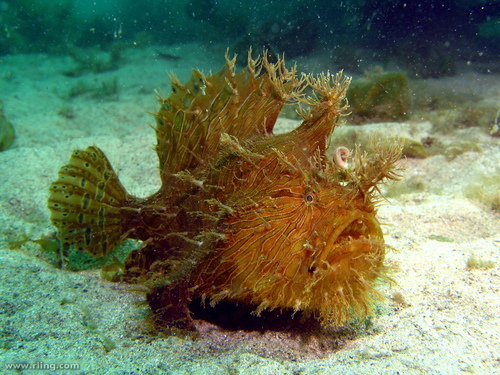
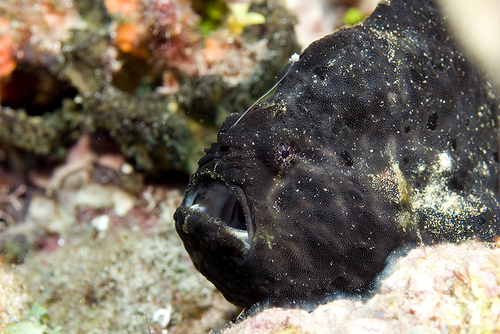
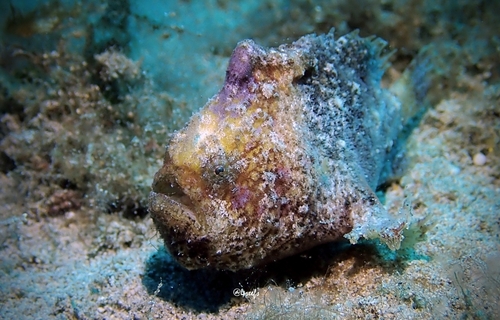
Antennatus tuberosus, first formally described by Cuvier in 1817, has a long illicium that is 50 to 100% longer than its second dorsal spine. The illicium tapers to a simple filamentous esca, also called a lure. Its second dorsal spine is cylindrical, while the third dorsal spine is enclosed in a raised bump within the skin. This species has no caudal peduncle. Its skin is thick and firm, lacks true scales, and is densely covered in bifurcated spinules. Its limb-shaped pectoral fins have a joint that resembles an elbow. The posterior edges of the dorsal and anal fins connect to the upper fin rays of the caudal fin. Body color is variable, but most individuals are cream, yellow, or slate grey, marked with dark brown reticulations and marbling. The face of the head has a whitish, crust-like patterned area. The anal and caudal fins have a distinct dark brown band, and additional dark bands along their margins. The maximum published standard length for this species is 9 cm (3.5 in).
Antennatus tuberosus occurs in the Indian and Pacific Oceans. Its range extends from Mozambique and Madagascar eastward to Hawaii and the Pitcairn Islands, northward to the Ryukyu Islands, and southward to New Caledonia and Tonga. In Australia, it is found on the northern Great Barrier Reef. It inhabits onshore coral reefs at depths down to 73 m (240 ft).