About Antennarius striatus (Shaw, 1794)
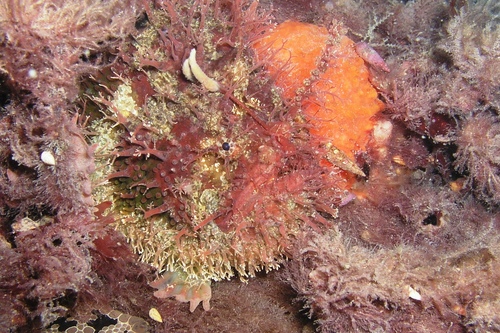
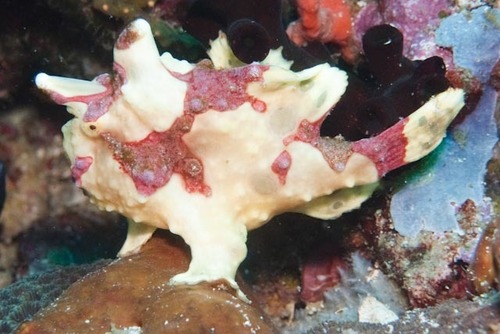
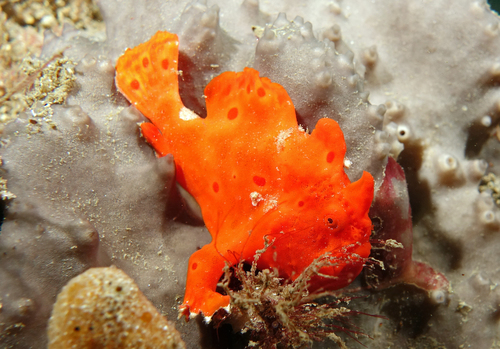
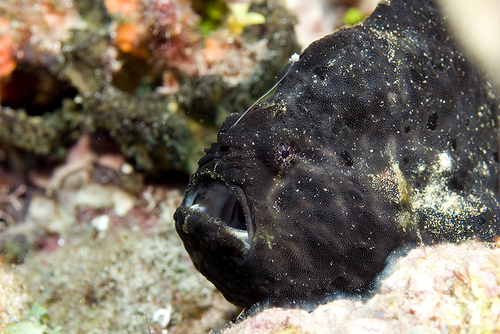
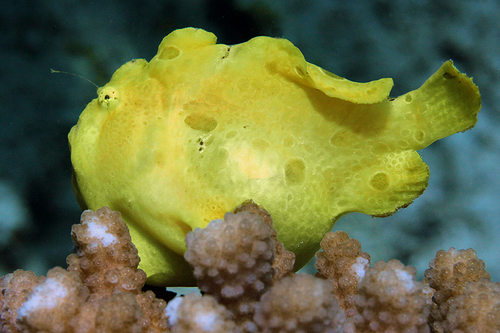
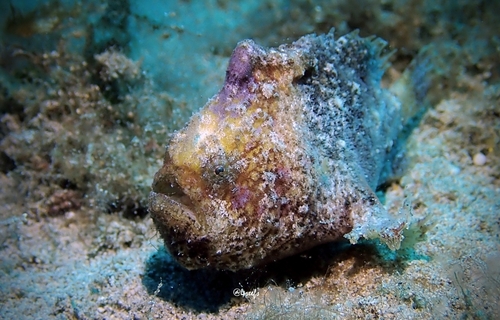
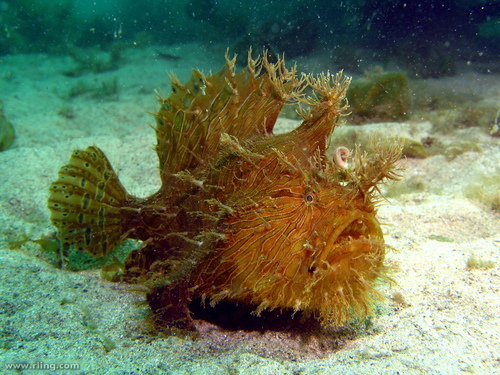
Antennarius striatus (Shaw, 1794), the striated frogfish, is a small fish that grows up to 22 cm (8.7 in) long. Like other frogfish, it has a rounded, extensible body, and its soft skin is covered with irregularly arranged hair-like dermal spinules. Its large mouth can extend forward to swallow prey as large as itself. Body coloration is extremely variable, as individuals match their living environments. Frogfish can change their coloration and pigment pattern, adapting to new conditions in only a few weeks. Dominant color ranges from yellow to brownish-orange across many shades, but individuals can also be green, gray, brown, almost white, or completely patternless black. Body and fins may bear roughly parallel dark stripes, elongated blotches, or rays radiating outward from the eye. The first dorsal spine, called the illicium, tips forward and is modified to work like a fishing rod. Its tip holds a characteristic worm-like esca (lure) that attracts unsuspecting prey when waved. This dorsal spine has two to seven elongated appendages. The lure is the feature that easily distinguishes A. striatus from Antennarius hispidus, which otherwise shares similar physical traits including stripes, coloration, and cutaneous appendages, and is often confused with A. striatus. The illicium is the same length as the second dorsal spine and is often darkly banded. The second dorsal spine is nearly vertical and movable, while the third dorsal spine bends toward the back of the body. All three dorsal spines are well separated from each other and from the main dorsal fin. The angled pectoral fins work together with the pelvic fins to let the frogfish "walk" across the sea bottom and hold a stable position for ambushing prey. The striated frogfish lives in tropical and subtropical waters. It is found from the Indian Ocean to the center of the Pacific Ocean, and in the Atlantic Ocean along the western coast of Africa and from the New Jersey coast to southern Brazilian coast, including the Gulf of Mexico and the Caribbean. It is not found only in the Mediterranean and the Arctic. Williams (1989) and Arnold and Pietsch (2012) consider Antennarius striatus a species complex. They note that the putative synonym Antennarius scaber is apparently a distinct species from A. striatus, with a bifid esca and 11–12 pectoral rays. This species lives in shallow sandy areas, rocky reefs, and coral reefs, and can also occur in deep waters. It can be found from the surface down to 210 m (690 ft), and is most commonly found at 40 m (130 ft) deep. It often mimics nearby coral or sponges to blend into its environment, a strategy called cryptic coloration. After moving into a new environment, it can change color over a few weeks to match its new surroundings. Rising daily global temperatures are a major threat to oceans and marine organisms that depend on stable marine ecosystems, and the striated frogfish is not an exception, as it relies on coral reefs for camouflage while preying on smaller fish. As oceans warm, their pH lowers, becoming more acidic and holding less oxygen. This causes coral bleaching on reefs, leading to daily loss of habitat: acidic conditions bleach coral, making it lose all its color. When coral loses its color, frogfish must adapt to blend in or become more vulnerable to predators. This adaptation has been observed in the species Antennarius maculatus, where frogfish have changed to a white color to blend in with bleached coral in the Indian Ocean.