About Antennarius multiocellatus (Valenciennes, 1837)
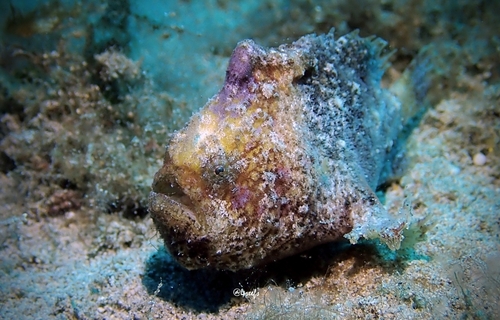
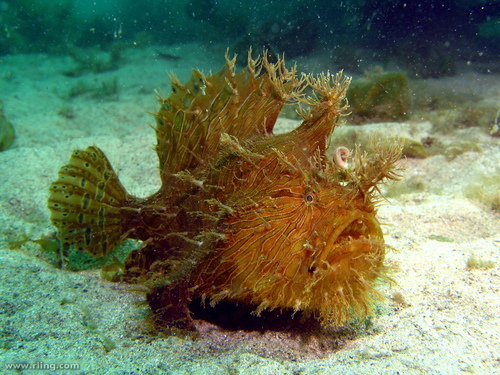
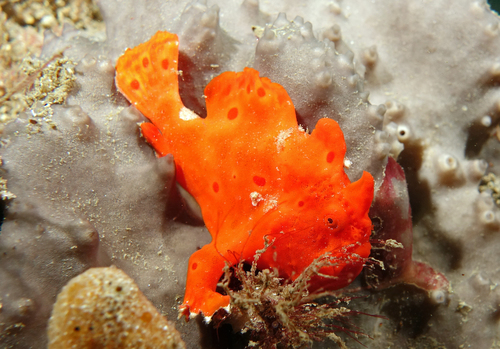
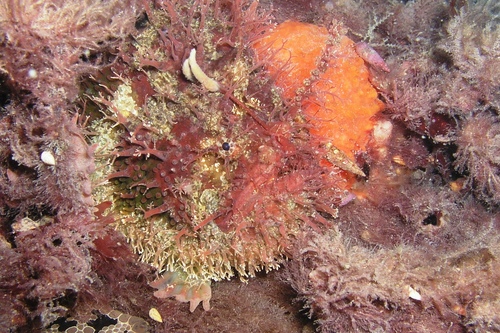
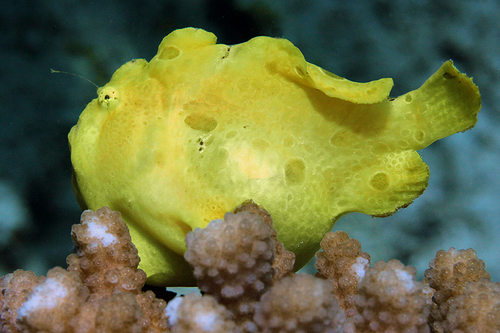
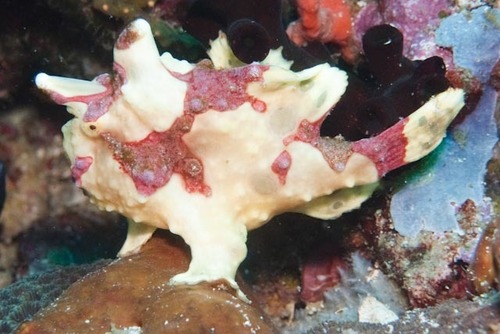
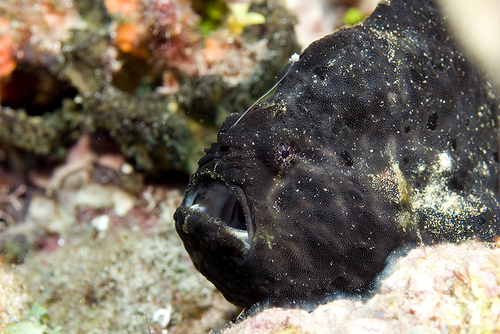
The longlure frogfish, Antennarius multiocellatus, is a bottom-dwelling species. It mimics surrounding sponges by adjusting its body color to match the area's dominant sponge, and has multiple eye-like ocelli markings that resemble sponge openings. It uses its stalked pectoral fins and pelvic fins to slowly walk across the sea floor. Individuals have been observed inflating their bodies by filling their stomachs with air or water. This is a solitary species that occurs in small populations. It is the most common frogfish species in the West Indies, and it is harmless to humans. The longlure frogfish is distributed across the Western Atlantic, ranging from Bermuda, the Bahamas, and eastern Florida; through the Gulf of Mexico from the Florida Keys and Flower Garden Banks to Tuxpan, and along the Yucatan Peninsula to Cuba; throughout the Caribbean Sea; and along South American coasts as far south as Salvador, Bahia in northeastern Brazil. Its range also extends to the Fernando de Noronha islands, and eastward to Ascension Island. This species inhabits shallow reefs at depths between 0 and 66 m (0 and 217 ft), and is especially found in areas with sponges. Like other frogfishes, the longlure frogfish spawns eggs encapsulated in a buoyant mucus mass called an "egg raft". This structure can carry a large number of eggs across large geographic distances. Spawning can be dangerous for this species due to its cannibalistic nature. Before spawning, the male and female walk across the bottom, with the female leading and the male following closely behind. The male's snout usually stays in immediate contact with the female's vent. During this period, the female is bloated with eggs, often swelling to twice her normal size. The pair then dashes to the surface, and the egg mass bursts out of the female. This species may spawn several times over the course of a few weeks.