About Antennarius maculatus (Desjardins, 1840)
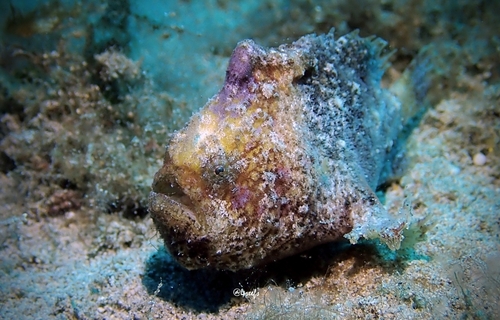
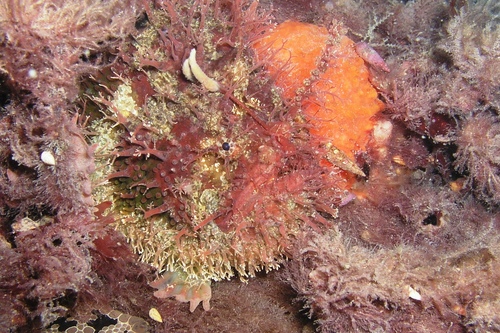
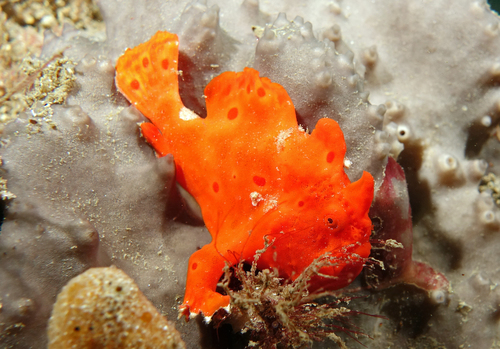
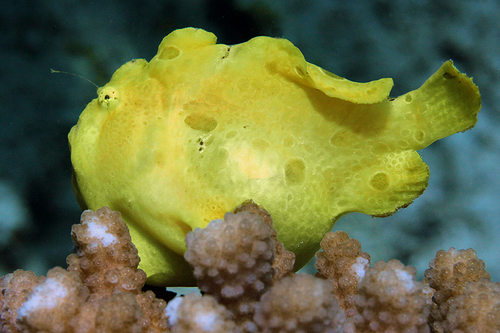
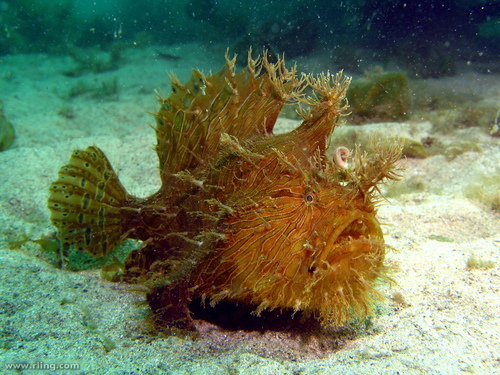
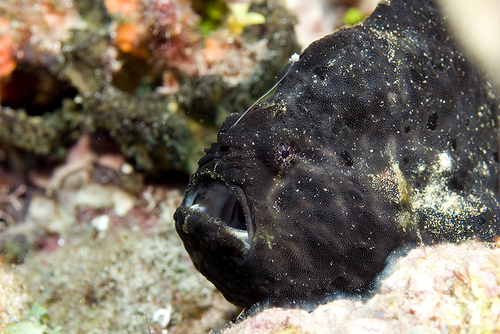
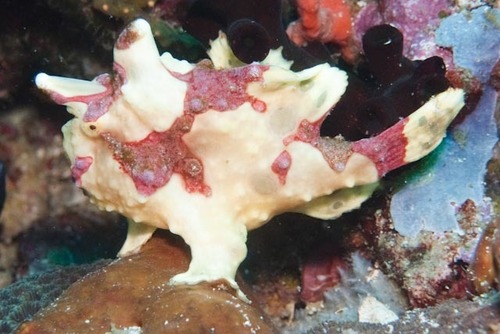
Antennarius maculatus, commonly called the warty frogfish, can grow up to 15 centimeters (5.9 inches) long. Like other frogfish, it has a round, extensible body, and its soft skin is covered in small dermal spinules and many small, wart-like bumps. Its large protruding forward mouth lets it eat prey that is as large as itself. Its body coloration is extremely variable because it tends to match its surrounding environment. Frogfish can change their coloration and pigment pattern over the course of a few weeks, and during coral bleaching events, they can even turn plain white to blend into their new bleached surroundings. Dominant body coloration ranges from white to black, spanning a full spectrum of related shades including cream, pink, yellow, red, and brown, often marked with dark circular spots and/or saddle-shaped markings. Heavily spotted individuals are often easily confused with the close relative Antennarius pictus. Two key characteristics can help distinguish A. maculatus: it typically has red or orange margins on all of its fins, and sometimes a point of the saddle blotch starts behind the eye. The first dorsal spine, called the illicium, is modified to act as a fishing rod. Its tip holds a distinct esca (lure) that looks like a small fish, with color ranging from pinkish to brownish. The illicium is twice as long as the second dorsal spine and is often marked with dark bands. The second dorsal spine is nearly straight and can move freely, while the third dorsal spine is bent toward the back of the body; both are attached to the head by membrane. These three spines are well separated from each other, and also well separated from the main dorsal fin. The pectoral fins are angled, and work with the pelvic fins to help the fish move across the seabed and hold a stable position while waiting to ambush prey. The warty frogfish shows biofluorescence: when exposed to blue or ultraviolet light, it re-emits this light as red, and has a different appearance than it does under white light. This biofluorescence may help with intraspecific communication and camouflage. A. maculatus lives in tropical waters of the Indo-Pacific, ranging from Mauritius and Reunion Island in the central Indian Ocean to the western Pacific Ocean. It inhabits sheltered rocky and coral reefs; adult individuals are most commonly found associated with sponges, at depths up to 20 meters (66 feet).