About Antennarius commerson (Lacepède, 1798)
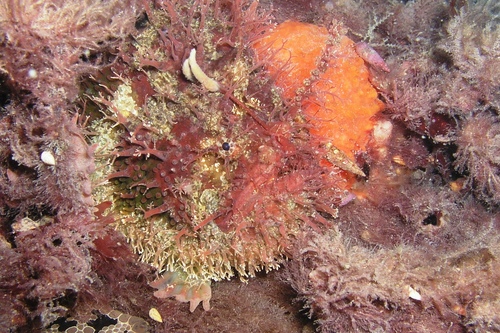
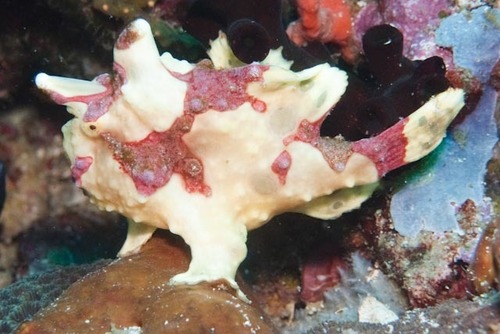
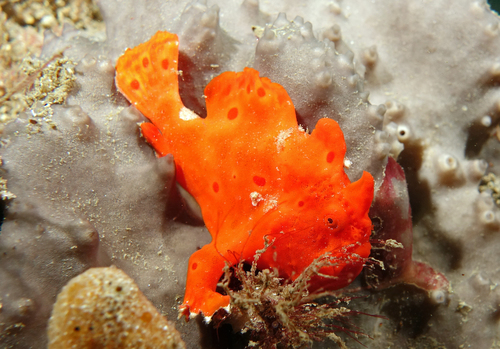
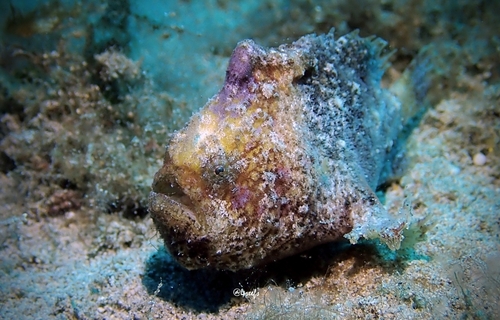
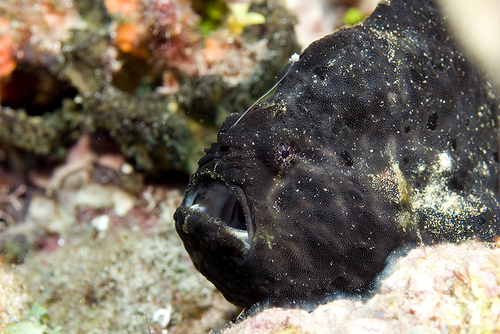
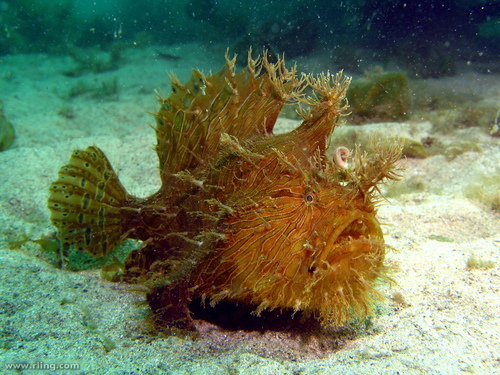
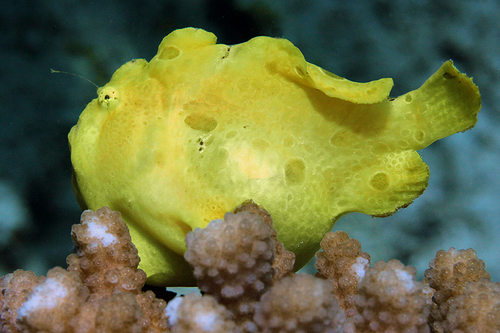
Commerson's frogfish, Antennarius commerson, reaches a maximum total length of 38 cm (15 in). Like other members of its family, it has a globular, extensible body. Its soft skin is covered in small dermal spinules, and is partially covered with a few small wart-like protuberances, variably shaped scab-like blotches, and a small number of small eye spots (ocelli) that resemble the holes in sponges. It has a large prognathous mouth, which lets it consume prey that is as large as itself. This species' coloration is extremely variable, as it matches its surrounding environment. Frogfish can change their coloration over the course of a few weeks. Dominant coloration ranges from grey to black, passing through a full range of related hues including cream, pink, yellow, red, and brown. Individuals usually also have circular eye spots or blotches that are darker than their background coloration. Juvenile Commerson's frogfish can easily be confused with the related species Antennarius maculatus and Antennarius pictus. To distinguish these species: A. maculatus usually has red or orange margins on all of its fins, and has numerous warts on its skin; A. pictus is covered in ocelli, and has three eye spots on its caudal fin. The first dorsal spine, called the illicium, is modified to work as a fishing rod. Its end has a characteristic esca (lure) that looks like a small fish or shrimp, and ranges in color from pinkish to brownish. The illicium is twice the length of the second dorsal spine, and is often darkly banded. The second dorsal spine is nearly straight and mobile, while the third dorsal spine is bent toward the back of the body. Both the second and third dorsal spines are attached to the head via membrane, are well separated from each other, and are also well separated from the dorsal fin. Antennarius commerson inhabits tropical and subtropical waters from the Indian Ocean to the eastern coasts of the Pacific Ocean. It occurs in lagoons and sheltered rocky and coral reefs. It is usually associated with large sponges, and can be found on underwater ropes, jetty pillars, and any other structures down to 70 m (230 ft) deep, with an average occurrence depth of 20 m (66 ft).